
Homeowners often book tree work because a canopy looks messy, blocks winter sun or looms too close to the roof. A few quick cuts feel harmless, yet poor technique can set a healthy gum, elm or ornamental pear on a downward spiral. Branches become weak, decay creeps in and the very shade asset you paid for needs removal years early. The problem isn’t the idea of cutting, it’s how, where and why the cuts are made. Below we unpack the hidden cost of bad lopping, show you warning signs to watch for and outline greener options that keep Melbourne’s urban forest thriving. If you reach the point where a canopy reduction is unavoidable, professional help is still the safest route. Learn what to avoid first, then decide whether you need qualified, professional tree lopping instead of DIY shears.
Why Poor Lopping Hurts Trees More Than You Think
Every cut is a wound the tree must compartmentalise – a biological defence that seals off cells to stop disease spreading. Large or misplaced cuts overwhelm that defence, exposing sapwood to fungi and borers common across Victoria. In our alternating dry summers and wet winters, the stress compounds:
- Summer heat accelerates dehydration through new sun-scalded wood.
- Winter rain pools on harsh, flush cuts, letting decay fungi establish.
- Fast regrowth after a heavy lop is weakly attached, snapping in the next northerly.
- Council tree-protection overlays may be breached, risking fines or replanting orders.
What looks like “tidy now” often equals “remove later” – an expensive, resource-hungry fate that contradicts Melbourne’s push for canopy cover.
The 7 Most Common Tree Lopping Mistakes
Incorrect lopping typically falls into predictable traps. Understanding them helps you brief an arborist, or avoid a weekend hack that ages your tree ten years overnight.
| Mistake | Immediate Appeal | Long-Term Tree Health | Risk to People & Property | Environmental Impact |
| Cutting flush with the trunk | No stub visible | Removes natural healing tissue; decay spreads into trunk | Future failure at cut site | Reduces carbon storage; creates unnecessary waste |
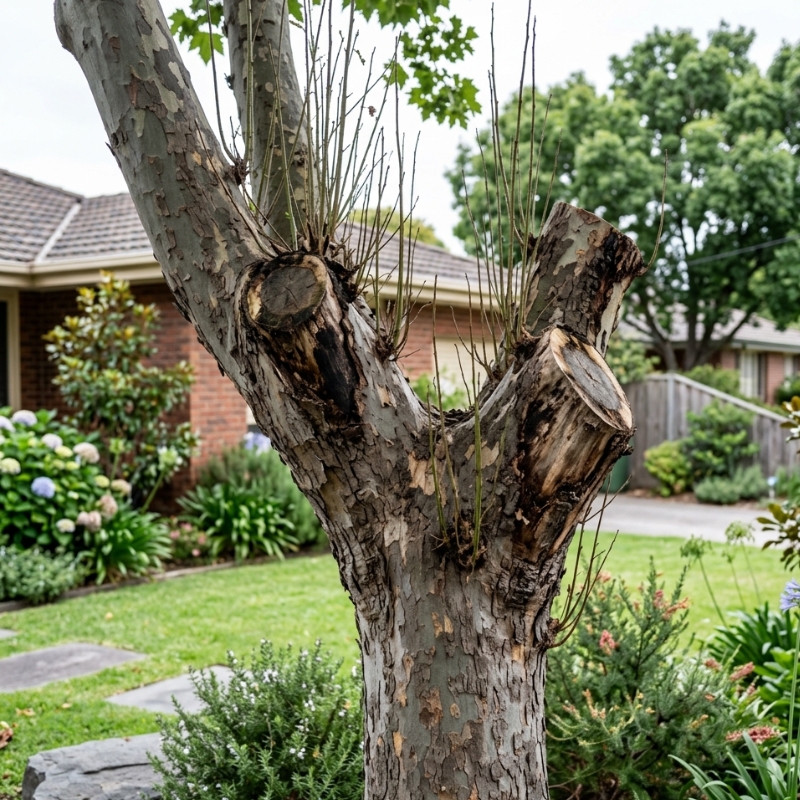
| “Topping” the main leader | Reduces height quickly | Stimulates clusters of weak shoots (“water sprouts”) | Branches snap under weight/storms | Reduces habitat; repeat work needed |
| Removing more than 25% of canopy in one hit | Instant light gain | Starves tree of energy, triggering decline | Sudden limb drop as tree stresses | Loss of shade and cooling benefits |
| Lion-tailing (stripping inner branches, leaving tufts on ends) | Airy look through canopy | Leaves long, heavy ends prone to breakage | Higher wind throw; branch failure | Forces future pruning, increasing emissions |
| Using blunt chainsaw or handsaw | Fast, ragged cut | Shredded fibres invite pathogens | Splintered limbs fall unpredictably | Greater green-waste due to extra cuts |
| Cutting during extreme heatwave | Easier access, less rain | Water stress hampers wound sealing | Increased sun-scald on exposed wood | Extra watering needed, impacting water use |
| Skipping sanitation between trees | Quicker workflow | Spreads pests like elm leaf beetle or diseases such as canker | Infestation can spread to neighbour trees | Bigger chemical footprint for control later |
Why “Flush Cuts” Are So Damaging
The branch collar – the slightly swollen ring where branch meets trunk – contains cells that form a protective callus. Sawing flush removes this natural barrier, leaving a doorway for rot. Even small flush cuts can hollow a tree within a few seasons.
The Hidden Dangers of Topping
Topping seems like a shortcut to maintain power-line clearance, yet it replaces one tall leader with several poorly attached shoots. Each can become a heavy limb in five years, multiplying failure points. Regrowth also rockets skyward, meaning more frequent, riskier work long-term.
How to Spot Damage from Incorrect Lopping Early
Catching problems in year one can save a mature tree:
- Dark staining or weeping sap around old cuts.
- Fungi brackets (conks) at or below pruning wounds.
- Multiple vertical cracks on new shoots.
- Rapid shoot growth clustered at the cut face.
- Dieback in upper canopy two summers after heavy reduction.
- Cavities forming where stubs were torn rather than clean-cut.
- New branches crossing or rubbing because too many emerged after topping.
Take clear photos each season. If the symptoms expand, a qualified arborist can advise remedial pruning or bracing before removal becomes the only option.
For a quick refresher on tree-health red flags, see our related guide on minimal pruning benefits.
Eco-Friendly Alternatives to Heavy Lopping
Melbourne councils now encourage canopy retention for heat-island mitigation. Eco-focused methods limit stress while meeting safety goals.
1. Crown Thinning
Selective removal of small, interior branches to improve airflow and reduce wind sail without altering tree silhouette.
2. Crown Reduction (Not Topping)
Shortens outer branches back to a suitable lateral limb, maintaining natural form and avoiding water sprout clusters.
3. Directional or Target Pruning
Removes specific limbs growing toward power lines or windows, guiding growth elsewhere instead of blanket removal.
4. Formative Pruning of Young Trees
Small early cuts establish strong structure, preventing drastic lopping later.
Introducing a side-by-side view helps clarify:
| Approach | Suitable For | Canopy Change | Stress Level | Typical Re-Prune Interval |
| Heavy lopping/top cutting | Immediate height reduction | Severe, unnatural | High | 2–3 yrs (regrowth) |
| Crown reduction | Oversized canopy near assets | Moderate, retains form | Medium | 5–7 yrs |
| Crown thinning | Wind-sail reduction, dappled light | Subtle shape retention | Low | 5–10 yrs |
| Formative pruning | Young trees <5 m | Minimal now, shapes future | Very low | 3–5 yrs |
Seek Local Guidance Before You Cut
Tree-protection overlays vary from Yarra to Moonee Valley. The Victorian environment guidelines outline when native or significant trees need a permit. Always confirm with your council before touching large limbs.
DIY vs Professional: Weighing Safety and Sustainability
Handling a handsaw for a 20 mm branch is one thing; manoeuvring a chainsaw five metres up a ladder is another. Consider:
- Access: Tight inner-city lanes limit equipment but also raise drop hazards for neighbours.
- Insurance: Home policies rarely cover damage from unauthorised tree work.
- Tool hygiene: Arborists clean gear to stop pathogens moving suburb to suburb.
- Recycling: Professionals chip and distribute mulch, cutting landfill waste.
- Wildlife: A licenced arborist checks for nesting possums or birds before cutting.
When the stakes include power lines, two-storey roofs or protected species, professional assessment avoids both environmental and legal fallout.
Mistakes to Avoid When Planning Tree Work
- Booking during January heatwaves – trees and workers are already stressed.
- Ignoring underground services – roots anchor stability; cutting them destabilises trunks.
- Chasing “cheapest quote” without sighting public liability cover.
- Forgetting post-lop watering – canopy loss equals less shade and higher moisture demand.
- Over-mulching the root zone after heavy cuts – thick mulch traps moisture against weakened trunks.
Quick Homeowner Checklist Before Any Cuts
- Have I identified the exact goal? (wind-sail, sun, clearance)
- Is there a council overlay or wildlife habitat to consider?
- Can selective cuts achieve the same outcome?
- Do I have sanitary, sharp tools for branches under 25 mm?
- For larger limbs, have I obtained two insured arborist quotes?
- What follow-up care (watering, monitoring) will the tree need?
Frequently Asked Questions
1. Will a heavily lopped tree always die earlier?
Not always, but heavy lopping accelerates decline in many species. The loss of the canopy starves the tree while large wounds invite decay. Some hardy species recover, yet even they often form weak branches that need ongoing pruning. Gentle, well-placed cuts extend lifespan far better.
2. How much of a canopy can I safely remove in one session?
As a rule of thumb, keeping removal below 25 percent of the live canopy limits stress. For mature eucalypts and elms common in Melbourne, even 20 percent can be risky if the tree is drought-stressed. When in doubt, stage work over two seasons.
3. Is winter really the best time for lopping in Victoria?
Late winter is ideal for many deciduous trees because sap flow is low and leafless branches reveal structure. Some natives prefer late summer once growth slows. The key is avoiding extreme heat or heavy rain periods that hamper wound closure.
4. Can I seal large cuts with pruning paint?
Modern arboriculture research shows most pruning paints trap moisture and foster decay. Clean, angled cuts at the right location heal better when left uncovered.
5. What’s the difference between lopping and pruning?
Lopping generally means large, indiscriminate cuts made for quick size reduction. Pruning is targeted, science-based trimming to improve health, structure or safety. Good pruning avoids the pitfalls associated with lopping.
Nurturing Melbourne’s Urban Canopy
Choosing thoughtful cuts over drastic lopping keeps your trees stronger, safer and better for the planet. When you weigh up risks, local regulations and the ecosystem services a mature tree provides, eco-friendly pruning or staged reduction often wins. If you ever feel the job is bigger than your hand saw – or council rules confuse you – a certified arborist can balance safety with sustainability, leaving your garden and neighbourhood greener for decades.