

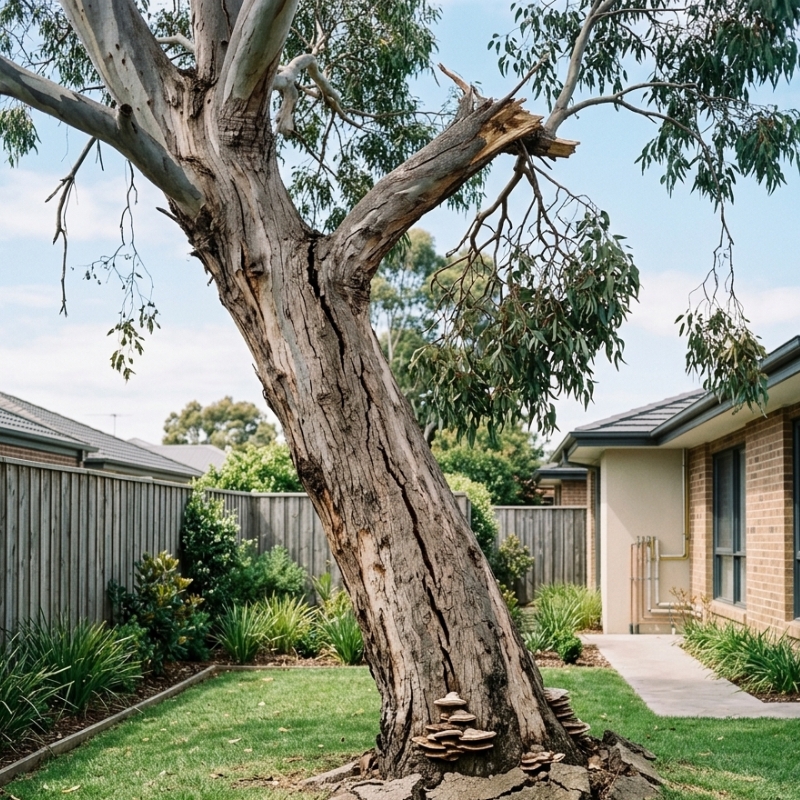
Why Homeowners Are Talking About Tree Risk
Every damaging storm that rolls through Melbourne sends the same wave of phone calls, from leafy Deepdene to the wind-tunnel streets of Point Cook. People look up at the towering eucalypt or the ornamental pine that has framed their garden for thirty years and, for the first time, wonder about it properly. For some properties, arranging professional tree removal turns out to be urgent. For plenty of others, a measured pruning program is entirely enough. Knowing where the line sits between a magnificent feature and a genuine liability is the whole question.
How Healthy Trees Turn Hazardous
A tree does not become dangerous overnight. It gets there gradually, and the pressures are the ordinary ones found in most Melbourne backyards:
- Soil compaction from constant foot traffic, which strips oxygen from the root zone and shows up as die-back in the crown.
- Repeated summer heatwaves are drying the clay sub-soils of the western suburbs, shrinking root plates and quietly reducing anchorage.
- Sudden gust fronts coming off Port Phillip Bay, which put torsional loads through tall gums.
- Poor pruning and topping above all. It leaves large wounds that never properly compartmentalise, and every one of them is an open door for decay fungi.
On its own, any single stress is usually survivable. Stacked together, they eat away at structural integrity until the sound wood that remains can no longer carry the wind and weight loads it is being asked to carry. That is the point at which the tree becomes a credible risk to people, property or utilities.
Visible Warning Signs You Can Spot Early
Most people can spot a dead tree. The subtler clues turn up months earlier, and they are the ones worth learning:
Unbalanced Canopy
A crown leaning heavily one way, or carrying a sudden void where branches have already dropped, is telling you the loading is asymmetric. That imbalance is what turns a strong wind into a failure.
Re-sprouting After Topping
If a tree was lopped a few years back and is now throwing out dense upright shoots, take that seriously. Those epicormic branches are shallowly attached, and they snap. Meanwhile, the original topping wound underneath them is quietly rotting.
Soft, Crumbly Trunk Wood
Tap around the base with the handle of a screwdriver. A hollow drum sound, or bark that flakes away under light pressure, points to internal rot even when the outside still looks perfectly solid.
Fungal Brackets
Conks from Ganoderma species, or a sulphur shelf (Laetiporus sulphureus), are fruiting bodies. The fungus was already inside the tree long before the bracket appeared, which means the structural cross-section has been reduced. They are a symptom, not the beginning.
Heaving Soil or Cracked Pavement
Small fissures radiating out from the trunk base, or pavers starting to lift, suggest the root plate is moving more than it should. That is a tree telling you it is already halfway to falling over.
Photograph these things, with dates. A timeline is useful if you later need to claim storm damage or to demonstrate urgency to a council that wants to know why you did not act sooner.
Hidden Risks Only a Qualified Arborist Confirms
Some threats stay invisible until someone brings the right equipment and training:
- Internal cavities, mapped with sonic tomography. It shows how much sound wood is actually left, and once the residual wall gets thin relative to the stem radius, removal climbs the list. There is no single magic percentage here, whatever anyone tells you. It is a judgement call made against species, loading, and what sits within falling distance.
- Armillaria root rot, which is a root and butt pathogen rather than something that colonises a pruning wound in the crown. It is usually confirmed by finding white mycelial fans under the bark at the root collar and black bootlace rhizomorphs in the soil, because the above-ground symptoms look almost exactly like drought stress.
- Co-dominant stems meet at a tight V-shaped union, which often conceals included bark. The bark stops the two stems from ever properly fusing, so the join is far weaker than it looks. Resistograph testing gives you a density profile through it.
- Trees near powerlines, which must meet the clearances set by Energy Safe Victoria. Non-compliance is an issue well before a branch actually touches anything.
An experienced AQF Level 5 consulting arborist weighs all of that against species profile, age, site exposure and target occupancy, which is the unglamorous term for how often people or valuable things are standing within strike distance. Their written risk assessment is what tells you whether the answer is mitigation, retention with monitoring, or removal.
Before scheduling any work, check what actually governs your block. Pull the planning property report for your address from VicPlan, and read up on tree removal permits in Melbourne. Many councils set trunk circumference or height thresholds, some suburbs sit under a Vegetation Protection Overlay or an Environmental Significance Overlay, and certain species stay protected despite obvious defects.
Legal and Insurance Implications in 2026
Property owners owe a duty of care once a hazardous condition is reasonably foreseeable. Ignore a tree you had good reason to worry about, and the fact that a freak wind finally brought it down may not save you from a negligence claim. This is general information rather than legal advice, and if the stakes are high you should get your own.
Here is the part most homeowners get wrong, and it cuts both ways. Victorian planning schemes do carry an emergency exemption: where vegetation presents an immediate risk of personal injury or damage to property, you can remove or lop it without a permit. But read the limit carefully, because it is narrow. The exemption covers only the part of the tree posing that immediate risk, and only the minimum extent necessary. A single hazardous limb does not licence you to take the whole tree out. Get an arborist to inspect and put their advice in writing, and keep it. Councils also expect pruning to be carried out in line with AS 4373, Pruning of Amenity Trees, and several will not accept work that was not.
Felling a protected tree without the right permit attracts penalties that run well into the thousands, and depending on which control applies and how the matter is prosecuted, a great deal higher than that. Homeowners in heritage precincts such as Fitzroy North should be especially careful, since the vegetation controls there frequently sit inside a planning overlay rather than the local law, and people check the wrong one. On insurance, policies vary enormously. Most cover sudden impact and exclude the slow damage of a limb scraping a roof for years. Read your own PDS rather than trusting a summary, this one included.
Practical Steps for Melbourne Homeowners
- Take baseline photos after major pruning or after a storm, so that future change actually stands out against something.
- Book a Level 2 visual tree assessment every two years for mature specimens, and go annually on large eucalypts above 20 m.
- Keep irrigation away from the trunk. Permanently wet bark is an invitation to fungal entry.
- Mulch out to the drip line with coarse wood chips, which moderates both soil moisture and soil temperature.
- Have a certified arborist put a risk rating in writing before and after any mitigation work. Councils and insurers both care about that paper trail, and it costs very little to build.
If removal does become unavoidable, think about where the timber goes. Slabs or mulch. A lot of Melbourne operators now work with community gardens, which turn what would have been landfill into something that builds soil.
Further best-practice advice appears in the Victorian Government tree safety guidelines, which cover homeowner responsibilities and set out how the emergency removal provisions work in practice.
Regular observation, backed by expert assessment when it matters, is what keeps a beautiful mature tree standing where it can safely stand and takes out the ones that genuinely cannot. Watch for the warning signs and act before the next southerly front, not during it.