
A lot of pruning problems don’t show up straight away.
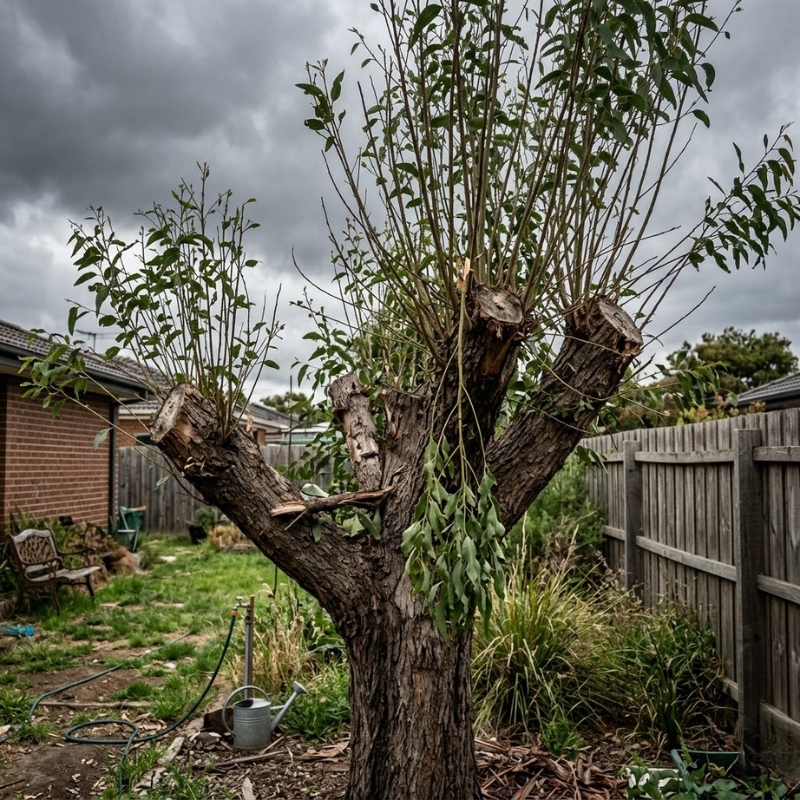
Right after a hard cut, a tree can look “tidy” and even healthier because there’s more light and less canopy. Then, a few months later, you start seeing the real consequences:
• long, whippy shoots that snap in the wind
• clusters of regrowth that thicken the canopy and create weak junctions
• dead stubs that won’t seal properly
• decay that creeps back into the main limbs
• cracks forming where heavy regrowth loads up a weak union
If you’re in Melbourne, the stakes are higher than people think. Trees here often have fast seasonal growth spurts, wet ground during parts of the year, and wind events that test poor structure. A small pruning mistake can turn into a big future failure.
This guide breaks down the most common pruning mistakes (including the sneaky ones), what they do to tree structure, and what to do instead. For the “what’s considered good practice?” benchmark, we’ll reference an Australian standard explainer that’s widely used in the industry: AS 4373-2007 pruning guidance explainer.
Why bad pruning creates weak regrowth (and why that matters later)
Trees don’t “heal” like humans. They seal wounds by growing new wood around the cut. When cuts are made in the wrong place, or too much canopy is removed at once, trees respond with survival growth rather than strong, well-attached structure.
That survival growth often looks like:
• dense tufts of shoots near the cut point
• very fast, upright shoots
• attachments that are weaker than normal branches
• a canopy that becomes top-heavy or unbalanced
Over time, those weakly attached shoots can become the branches that snap in storms.
Quick check: you might be looking at bad pruning if…
• you see lots of thin upright shoots sprouting from a cut point
• you see big stubs left behind (dead ends that never sealed)
• the tree looks “lion-tailed” (foliage only at the ends of branches)
• cuts look flush to the trunk (like a flat shave)
• the canopy is suddenly lopsided or dramatically thinned on one side
If you want a simple list you can keep and refer to, this article doubles as a tree pruning mistakes to avoid reference when you’re walking around the yard.
Mistake 1: Topping (the biggest cause of weak regrowth and breakage)
Topping is when the top of a tree (or major limbs) is cut back to stubs or random points, rather than to appropriate lateral branches.
Why it’s a problem:
• it removes the tree’s natural structure in one hit
• it forces survival regrowth (fast, upright shoots)
• those shoots often attach shallowly and can snap later
• it creates large wounds that are harder for the tree to seal
• it can start a cycle: regrow fast → cut again → regrow weaker → higher failure risk
What to do instead:
• use reduction cuts (cutting back to a suitable lateral branch)
• consider staged reduction over time rather than one drastic hit
• focus on removing specific hazards (deadwood, crossing limbs) instead of “shaping the whole tree”
Q&A: “But topping keeps the tree smaller, doesn’t it?”
It often makes the tree more aggressive. Many species respond by throwing heaps of fast regrowth. You end up with a tree that’s harder to manage and more prone to future branch failure.
Mistake 2: Flush cuts (cutting too close to the trunk)
A flush cut is made tight against the trunk, removing the branch collar (the natural swelling where a branch joins the trunk).
Why it’s a problem:
• the branch collar helps the tree seal the wound
• removing it leaves a bigger wound and disrupts sealing
• decay can progress more easily into the trunk
• wounds can stay open longer, inviting pests and disease
What to do instead:
• cut just outside the branch collar (not into it, not leaving a long stub)
• aim for a clean cut that supports natural sealing
A lot of homeowners spot this mistake later because the cut area becomes a persistent scar, starts cracking, or shows signs of decay.
Mistake 3: Leaving stubs (the “it’ll be fine” cut that rarely is)
A stub cut leaves a chunk of branch sticking out beyond where it should be cut.
Why it’s a problem:
• stubs often die back
• they don’t seal neatly
• they can become entry points for decay
• they can create weak regrowth clusters around a dead end
What to do instead:
• if you’re removing a branch, remove it properly at the correct point
• if you’re reducing length, reduce to a suitable lateral branch (not to “thin air”)
Q&A: Why do stubs stay dead for years?
Because there’s no living tissue beyond the stub to keep it active. The tree can’t “finish the job” cleanly, so you get dieback, then decay, then potential failure at the stub base.
Mistake 4: Removing too much canopy in one go
A common rule of thumb is to avoid removing a large percentage of the canopy all at once. Heavy removal can stress the tree and trigger survival regrowth.
Why it’s a problem:
• the tree loses too much energy-producing leaf area
• stress response creates lots of fast, weak shoots
• sunburn can occur on previously shaded limbs
• canopy imbalance increases wind load in the wrong places
What to do instead:
• stage major changes over time
• prioritise hazard removal and structural improvements
• focus on targeted cuts, not “stripping the tree”
If you’re unsure whether your plan is “light maintenance” or “major canopy change”, getting corrective pruning advice early can prevent that boom-and-bust regrowth cycle that causes breakage later.
Mistake 5: Lion-tailing (stripping inner growth and leaving foliage at the tips)
Lion-tailing happens when interior branches are removed, and foliage is left mainly at branch ends.
Why it’s a problem:
• it shifts weight to the ends of limbs
• it increases leverage and swing in the wind
• it can lead to branch cracking at unions
• it reduces the tree’s ability to dampen wind movement through the canopy
What to do instead:
• thin selectively (if needed), keeping a balanced distribution of foliage
• avoid over-cleaning the inner canopy
• retain smaller interior laterals that support the structure
Q&A: Isn’t thinning always good for wind?
Not if it’s done poorly. A balanced canopy can move wind through it. A lion-tailed canopy can act like a set of heavy levers at the ends of branches.
Mistake 6: Cutting at the wrong time (or during heat/wind stress)
Timing depends on species, tree condition, and what you’re cutting. But there are common timing mistakes:
• pruning during extreme heat or drought stress
• pruning during very windy periods
• pruning when the tree is already struggling (dieback, pests, root issues) without a plan
Why it’s a problem:
• stressed trees seal wounds more slowly
• regrowth can be weak or patchy
• dieback can increase if the tree is already under pressure
What to do instead:
• time pruning to minimise stress and support recovery
• avoid “panic pruning” right before rough weather
• if the tree looks unwell, diagnose the underlying issue first (waterlogging, compaction, pests)
Mistake 7: Bad cut selection (heading cuts where a reduction cut is needed)
Two cuts people confuse:
• Heading cuts: shorten a branch without cutting back to a suitable lateral
• Reduction cuts: shorten a branch by cutting back to a suitable lateral branch that can take over growth
Why it matters:
• heading cuts often trigger dense, weak regrowth at the cut point
• reduction cuts guide growth into an existing branch structure
• heading cuts can create a “tuft” that becomes a weak cluster
What to do instead:
• reduce to a lateral branch of suitable size and direction
• aim for cuts that preserve structure rather than creating a regrowth “broom”
Mistake 8: Creating canopy imbalance (one-sided pruning)
This one is easy to do accidentally: you prune the side over the driveway or roof, but leave the other side untouched.
Why it’s a problem:
• the tree becomes unbalanced
• wind load increases on the heavier side
• the trunk can develop stress and lean over time
• regrowth concentrates where you cut hardest, which can worsen imbalance
What to do instead:
• plan pruning as a whole-tree strategy, not just a clearance job
• make proportionate reductions
• consider staged work so you don’t over-strip one side
Mistake 9: Ignoring weak unions and including bark
Some branch unions are structurally weak from the start, especially tight V-shaped unions where bark is trapped (including bark).
Why it’s a problem:
• included bark unions can split under load
• heavy regrowth after poor cuts can overload these unions
• failures often occur without much warning during wind events
What to do instead:
• reduce end weight on limbs with weak unions
• remove competing stems early (formative pruning on younger trees)
• consider support systems in specific cases (not DIY territory)
Mistake 10: DIY pruning near powerlines (this is a hard stop)
If you can see overhead lines anywhere near the work zone, treat it as a no-go for DIY.
Why it’s a problem:
• it’s unsafe and can be fatal
• branches can swing or fall unpredictably
• even “small” cuts can rebound into a line
What to do instead:
• keep clear and get the correct authority/contractor pathway
How to spot weak regrowth before it becomes a breakage problem
Weak regrowth has a look and feel:
• lots of shoots emerging from one cut point
• shoots are long, upright, and packed together
• attachments look shallow or crowded
• the regrowth starts rubbing against itself as it thickens
• there’s no clear “leader” branch — just a cluster
As those shoots thicken, you get:
• poor branch spacing
• included bark forming in new unions
• heavy end-weight accumulating quickly
This is why topping and heavy canopy removal are breakage factories.
Q&A: If my tree already has weak regrowth, can it be fixed?
Often, yes — but usually through staged corrective pruning. The goal is to:
• select better-placed shoots to keep
• remove or reduce poorly attached shoots over time
• rebalance the canopy
• reduce leverage on weak unions
If you’ve inherited a topped tree or a hacked canopy, here’s a practical next step: how to fix bad pruning starts with identifying the regrowth structure and planning staged correction rather than another harsh cut.
“Good pruning” in plain English: what you’re aiming for
You don’t need to memorise jargon. You just need a few outcomes:
• cuts that seal cleanly (not flush, not stubby)
• structure that spreads load (not all weight at the ends)
• a canopy that’s balanced (not one-sided)
• removal that’s targeted (deadwood, rubbing branches, hazards)
• changes staged over time when the job is big
For the benchmark language that councils and arborists refer to, the AS 4373 explainer is a useful reference point: AS 4373-2007 pruning guidance explainer.
A Melbourne-friendly “do this instead” checklist
If you’re trying to avoid future breakage, focus on these practical moves:
• Remove deadwood before it becomes a hazard
• Reduce end-weight on long limbs (to suitable laterals)
• Keep inner structure — don’t lion-tail
• Make cuts in the right place (outside the collar)
• Avoid removing too much at once
• Re-check regrowth the following season and thin/selectively reduce it
• Treat pruning as a multi-season plan for problem trees, not a one-off haircut
After a bad prune: what to do now (without making it worse)
If you’re looking at a tree that’s already been topped, stubbed, or over-thinned, your next decision matters.
1) Don’t “fix” it with more random cutting
More harsh cuts often lead to weaker regrowth.
2) Identify what’s actually dangerous right now
Immediate hazards include:
• hanging limbs
• cracked unions
• large dead branches over targets (roof, driveway, footpath)
• regrowth clusters that have started splitting
3) Plan staged correction
Staged correction usually means:
• selecting better regrowth to keep
• reducing weight gradually
• improving spacing
• reducing load on weak unions
4) Monitor during windy periods
Weak regrowth tends to fail under gusts and when limbs are wet/heavy.
FAQs
Is lopping the same as pruning?
Not really. Pruning is about maintaining health and structure with correct cuts. Lopping often means random shortening that can create stubs, weak regrowth, and a higher failure risk later.
Why do topped trees grow back so fast?
Because the tree is trying to replace lost leaf area quickly. That fast regrowth is often weaker attached than normal branch development.
What’s worse: flush cuts or stubs?
Both can be bad, just in different ways. Flush cuts remove the collar and can drive decay into the trunk. Stubs often die back and become decay entry points. Correct cut placement avoids both.
Can bad pruning kill a tree?
In severe cases, yes — especially if combined with other stresses (drought, pests, root damage). More commonly, it shortens the tree’s life and increases the risk.
How do I know when pruning is too risky to DIY?
If the branches are large, high, near powerlines, or over targets (roof, driveway, neighbour’s property), it’s time to stop DIY and seek proper assessment.