

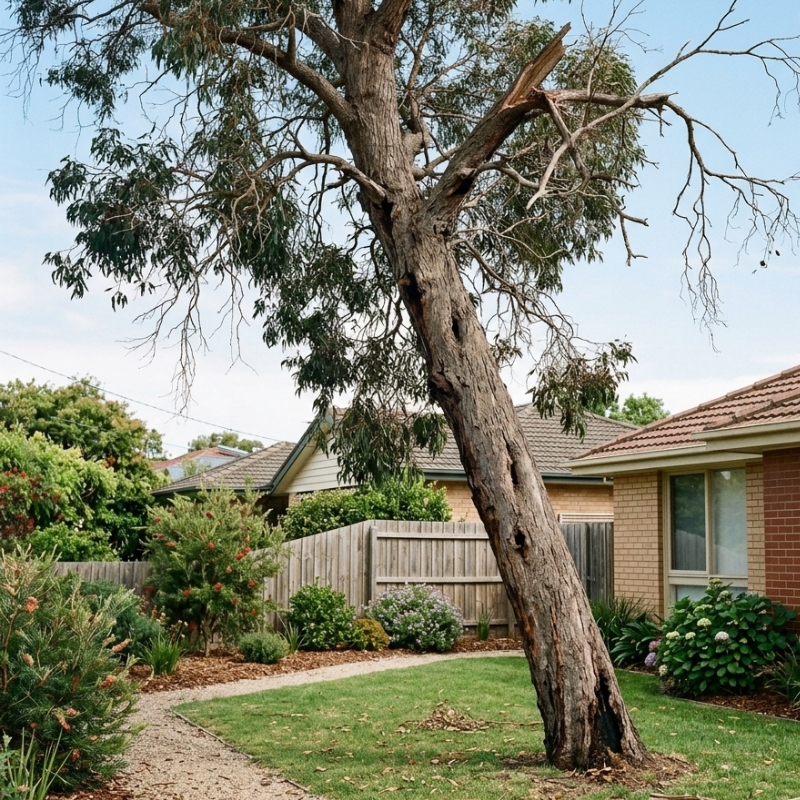
Early Warning Signs
Leaning trunks, splitting branches, or a canopy that suddenly looks sparse often point to structural weakness. A tree in this condition is far more likely to shed limbs during Melbourne’s spring windstorms and may need prompt assessment. If an arborist confirms advanced decay, removal rather than pruning is usually recommended. You can see examples of acceptable removal methods on our Melbourne tree removal service page for context on what’s involved.
Legal Triggers
Across metro councils, a tree protected by a Planning Scheme Overlay can’t be lopped without a permit, yet there are clear-cut situations where removal is required by law. For instance, if roots invade a stormwater pipe and cause a sewage back-up, most councils list “infrastructure risk” as valid grounds for immediate action. Insurance companies will also insist on documentation that the hazard was addressed in a reasonable timeframe; ignoring a council direction notice can void a claim after a storm. Keeping the paperwork tidy avoids a costly re-inspection fee and potential fines that run into the thousands.
Disease and Pest Spread
Canker, dieback and Armillaria are moving through certain eucalypt and pine species around the Yarra corridor. Because these pathogens spread through root grafts, leaving an infected tree standing can sacrifice otherwise healthy neighbours. An ISA-qualified arborist will core-sample the trunk, map the decay front and advise if a 10-metre exclusion zone is needed. When the disease front has breached 30 % of the cross-section, even advanced pruning won’t halt decline, and complete removal becomes the safer, cheaper path.
Structural Conflict With Buildings
Foundations, retaining walls and underground services do poorly against expanding buttress roots. If a root plate lifts pathways or cracks a brick fence, councils generally support removal under “unauthorised damage” clauses. Tell-tale clues include doors that suddenly stick, recurring slab hairline cracks, or a patio that now tilts enough to hold water. These issues cost far more to remediate than the tree itself. In new subdivisions with small lots, builders often bring us in during final inspection to remove a tree that was once ornamental but has outgrown the block.
Storm or Wind Damage
After a severe northerly, you’ll notice hangers—branches broken yet trapped in the canopy. Home insurance rarely covers the preventative pruning needed to stop them falling. If the branch is from a main leader, the weight imbalance can make the entire tree fail in the next gust. An arborist will calculate residual stem strength; once the loss exceeds roughly one-third of the crown, removal rather than bracing is commonly advised. Melbourne’s south-eastern suburbs see most failures in late October when saturated clay soil offers less anchor. Acting quickly avoids secondary roof and fence damage in the next storm cell.
For readers working through council red tape, our detailed guide on tree removal permits in Melbourne explains current overlay codes and application tips.
Overcrowding and Light Loss
Multiple trees planted too close fight for light. The weaker specimens become thin, then suddenly die back from the top. That decline invites borers which can migrate to healthy gums nearby. Strategic removal of one or two poorly placed trees often revitalises the remaining canopy and restores sunlight to vegetable beds or solar panels. Homeowners notice a drop in winter mould on eaves once extra light and airflow return.
Fire-Readiness Around Dwellings
The CFA’s “10/30” rule allows property owners in designated bushfire-prone areas to remove vegetation within ten metres of a dwelling—no permit needed. While inner-metro blocks sit outside this designation, peri-urban fringes such as Warrandyte, Eltham and Hurstbridge fall squarely inside. Removing a tree that forms a continuous fuel ladder from shrubs up to the canopy is one of the most effective ways to improve a home’s BAL (Bushfire Attack Level) rating. Waiting until January is risky; most crews are on asset-protection standby, and chipper availability tightens.
Age and End-of-Life Decline
Every species has a typical lifespan. A silver birch rarely thrives beyond 40 years in Melbourne’s climate. Past that point, cavities widen and the root zone shrinks. Annual pruning outstrips the aesthetic value of keeping the specimen. A planned removal lets you choose the timing, replant promptly and avoid the frenzy that follows a spontaneous collapse across a shared driveway.
Balancing Habitat and Safety
Not every suspect tree must go. Hollows in mature gums house possums, micro-bats and parrots. The goal is to decide whether selective limb removal, deadwood retention or full extraction is appropriate. Many homeowners keep a 5-metre spar as a habitat pole once major overhanging limbs are removed. A certified arborist writes the habitat retention plan councils look for when approving such compromises.
Preparing for the Decision
Gather the following before booking an arborist:
| Item | Why It Matters |
| Recent house plans | Locates sewer, stormwater and footings |
| Council overlay map | Confirms permit exemptions or needs |
| Insurance policy wording | Some require pre-approval for large trees |
| Photos after storms | Documents progressive damage |
Having this material ready shortens on-site assessments and speeds any permit submission.
Cost Factors to Expect
Tree species, trunk diameter, access for equipment and waste disposal fees drive cost more than height alone. In built-up suburbs such as Brunswick, the inability to get a 15-inch chipper down a narrow laneway can add several hundred dollars for manual drag-out. Stump grinding is generally priced separately; planning both jobs together avoids paying a minimum call-out twice.
Timing the Work
Late autumn and mid-winter tend to be quiet for removal crews, so prices soften slightly. Scheduling before property sale photos makes sense; banks sometimes flag “tree proximity” in valuation reports. Completing the job a fortnight before the photographer arrives lets mulch settle and freshens the outlook without bare earth showing.
Environmental Responsibility
Melbourne councils increasingly require proof that green waste goes to licensed composting facilities. The Yard recycles almost all chipped material into garden mulch for local landscaping yards, keeping it out of landfill. We also replant one native tube-stock for every significant canopy removed, usually in co-ordination with residents’ groups. While not mandatory, this practice strengthens permit applications that must show a net community benefit.
When Professional Advice Is Non-Negligible
If the tree in question exceeds your gutter line, sits within five metres of a dwelling or shows fungal fruiting bodies at the base, a DIY approach risks both personal injury and voided home insurance. A fall arrest system, drop zone calculation and spotter are not optional extras on urban blocks. The liability for damage to a neighbour’s roof or car rests solely with the property owner when unlicensed work is attempted.
Two industry standards apply:
- AS 4373-2007 for pruning and removal techniques
- WorkSafe Victoria “Managing Risks of Tree Work” code
An arborist who ignores these leaves you exposed if something goes wrong.
Final Observations
Knowing when a tree shifts from asset to liability is part observation, part regulation and part ecology. Look for structural faults, disease progress, conflicts with infrastructure and compliance deadlines. Combining those threads gives a clear answer on removal versus retention. Staying proactive reduces stress, cost and risk across Melbourne’s ever-changing urban forest.
For current municipal guidance on protected species lists and permit thresholds, the City of Melbourne maintains an updated resource at the Urban Forest Tree Removal page.