
If you are working out how to remove tree roots after a tree has come down, the honest answer is that you can safely handle the shallow surface roots yourself and should leave the rest to machinery. Thin feeder roots near the surface can be cut and lifted with a mattock and a sharp spade. The anchor roots running out from the stump are a different proposition: woody, deeper than they look, and often sitting alongside pipes, cables and footings. That is where grinding the stump and root plate out mechanically beats a weekend of digging. Here is how I would work through it, and where I would stop.
What is actually left in the ground
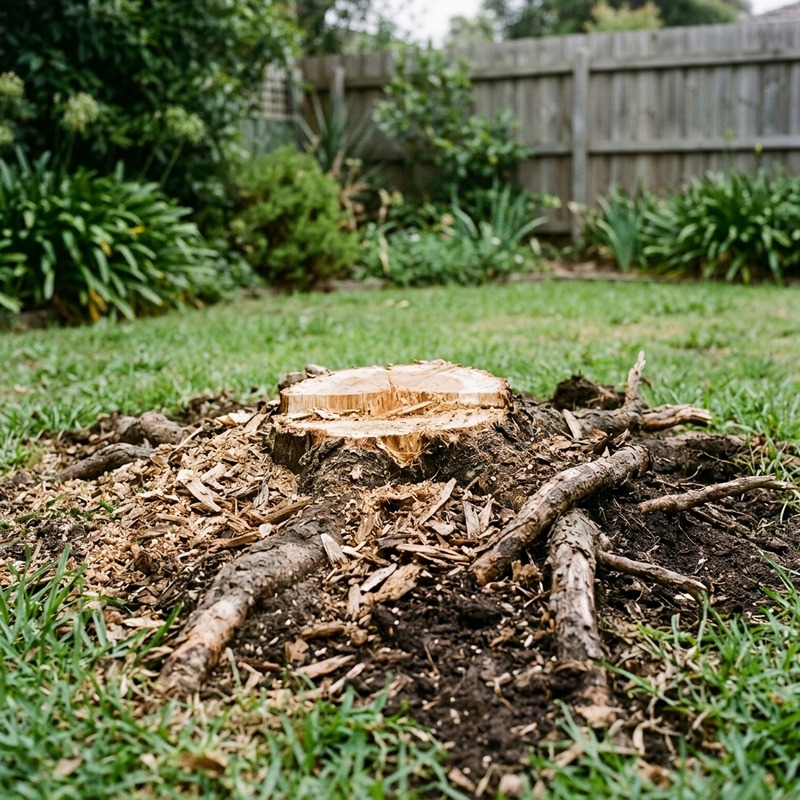
When a tree is felled, what remains is a stump plus a root plate, and the plate is wider than most people expect. Roots spread well beyond the old canopy line, mostly in the top 300 to 600 millimetres of soil, with a few sinker roots heading deeper for anchorage. So the roots causing your problems, lifting a path or catching the mower, are usually shallow and reachable, while the roots holding the stump are a dense interwoven mass immediately around it that will not come out by pulling.
A stump does not grow new roots once the canopy is gone, because no leaves remain to produce energy, so the system dies back and decays. Species that sucker, including eucalypts, willows, poplars and privet, can throw shoots from the stump or roots for a long while, and each shoot that gets leaves keeps part of that root system alive.
Surface roots you can deal with yourself
Soak the area a day ahead, because wet soil cuts more easily and you will do less damage to what you want to keep. Scrape the soil back until you can see the root’s diameter and where it runs. For anything up to wrist thickness, a sharp pruning saw or loppers will cut cleanly. Make two cuts and lift the section out rather than pulling a long length free, because pulling transfers force into the soil and anything buried in it.
Three limits are worth holding to. Do not cut roots within two to three metres of a tree you want to keep, because you remove both its water supply and its anchorage. Do not cut near footings, retaining walls, paving or a pool shell, where removing a root changes how the soil behaves. And if a root is thicker than your wrist or clearly structural, leave it and get advice.
Before any digging, arrange for underground services to be located. Gas, electricity, water, telecommunications and sewer can all run through a suburban backyard at shallow depth, and you cannot judge their position from the surface. The process to follow in Australia is Before You Dig Australia, the national referral service that provides asset owners’ plans for your address. Lodge an enquiry, read what comes back, and if anything shows near your work area, get a licensed locator on site.
Why some roots need machinery
Once you get to the stump itself, hand tools stop working. The root mass around a stump is thick, tangled and gripped by compacted soil, and the sinker roots give it enormous hold. Digging one out by hand usually produces a large hole, a stump that has not budged and a sore back.
A grinder works differently. Rather than lifting the mass out, a cutting wheel with carbide teeth chews the stump and main roots to below ground level, leaving fine chips and soil instead of a cavity, which is far easier to backfill and replant. Access decides what machine can be used, so gate widths, side paths, steps, slopes and soft ground all matter, and operators need to know what is buried nearby before the wheel goes in. A grinder has an exposed high-speed cutting wheel that throws debris, so it is not a hire item to teach yourself on. If the stump is large, close to structures or on a slope, bring in someone who runs one regularly and carries the right insurance.
What happens to all that chip
Grinding produces a surprising volume of material, because solid wood becomes chip and most stays on site. Expect a pile two or three times larger than the stump looked. Some goes back into the hole as backfill, though it settles as it breaks down, so overfill slightly and top up later. The rest can be used around the garden, and this is where putting the chip to work as mulch beats paying to send it away. Fresh grindings are coarse and high in carbon, so they suit paths, established shrubs or a heap left to age rather than a vegetable bed, where they tie up nitrogen. Keep chip off trunks, because piling it against bark invites rot, and if the tree came down with a root or butt disease, have those grindings taken off site.
When the whole tree still has to go
Sometimes the roots are not the real question. If the tree is still standing and its root system is already compromised, lifting at the base, soil cracking in an arc on one side, fungal brackets at the collar, roots severed by earlier excavation, then nothing you do to the surface roots addresses the risk. A damaged root plate can fail in a wind while the canopy looks healthy. There the sequence runs the other way: assessment first, removal if warranted, stump and roots afterwards. An arborist looks at the base, the lean, the soil and the history of works around the tree, and that assessment is the starting point for the kind of tree work carried out across Melbourne. If the tree is protected under your council’s rules, the council will want to see it, so check before arranging removal.
A word on chemical root killers
The question that comes up most is whether something can be poured on to kill the roots fast. Products marketed for this exist, and there are good reasons to be cautious with them in a backyard.
They do not make roots disappear. Killing root tissue does not remove it, so the wood still has to break down or be ground out, and you have added chemical to the soil without solving the physical problem. Roots are also not isolated. They run under lawns, garden beds, driveways and fence lines, often tangled with plants you want to keep, so anything moving through a root system can reach neighbouring plantings or cross a boundary. Roots head for moisture too, which is why they find drains and damp spots, so a soil-active chemical applied around them can end up somewhere you did not intend. These products are registered for particular uses only, and the APVMA is the authority that approves agricultural and veterinary chemicals in Australia and sets what each product may legally be used for, so label conditions are not optional. If a stump needs to go, grinding deals with it in an afternoon and leaves usable mulch instead of treated soil.
Getting it sorted
Handle the shallow surface roots yourself once services are located, and hand over anything structural, near buildings or involving the stump. If a stump and root mass is sitting in your yard, The Yard can take care of it. Request a quote here.
Frequently asked questions
How to remove large roots from the ground? Large woody roots are not a hand tool job. They are cut and ground out mechanically, as part of grinding the stump or with an excavator where the root runs further out. Expose the root to confirm its size and direction, then get machinery in if it is thicker than your wrist, structural, or near footings, paving or buried services.
Do tree roots keep growing after a tree is cut down? No. Without leaves, the tree cannot photosynthesise, so the root system has no energy source and dies back and decays. What can happen is suckering: eucalypts, willows, poplars and privet may send shoots from the stump or roots, and once those shoots carry leaves, they keep that section of root alive. Removing shoots as they appear, or grinding the stump out, ends it.
How to uproot a tree? Whole tree uprooting, stump and root plate together, is done with machinery such as an excavator and leaves a large void needing backfill and compaction. It is only worth it when the ground is being redeveloped or levelled. For an ordinary backyard, felling and grinding the stump is less disruptive. Either way, it is not a DIY task.
What kills tree roots fast? Killing roots does not remove them, so the wood still has to decay or be ground out, and chemicals applied around a root system can travel through soil and water into plants you want to keep, into drains or across a boundary. These products are registered for specific uses, and the APVMA sets what each may be used for. Grinding is more predictable and leaves soil you can replant into.