
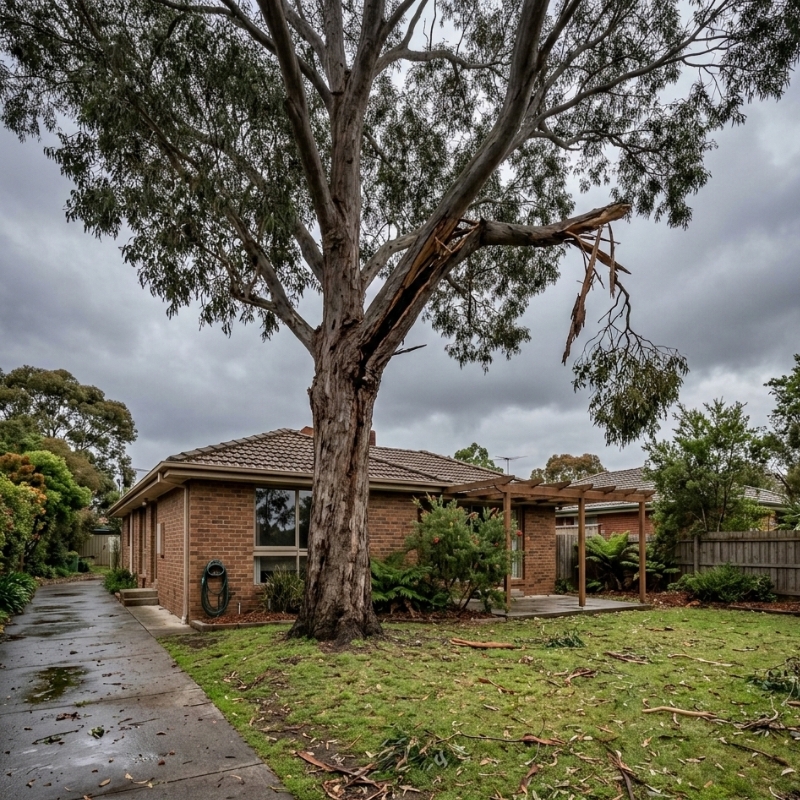
Dangerous tree branches don’t always look dramatic. In Melbourne, a limb can fail after wind, heavy rain, heat stress, or years of slow decay you can’t see from the outside. The goal of this guide is to help you spot the most common red flags early, so you can reduce risk around your home, family, neighbours, and property.
You’ll get a simple step-by-step checklist, an “urgent vs monitor” triage system, and clear guidance on when a homeowner check is enough and when it’s time to bring in a qualified arborist.
Start with the safety rule: don’t stand under the problem
Before you inspect anything, do a quick safety reset:
• Do your first check from a distance (across the yard or from indoors).
• Keep kids and pets away from the drop zone.
• Don’t climb ladders, roofs, fences, or trees to “get a better look”.
• Never touch branches near powerlines (even if the line looks insulated).
• If a branch is hanging, cracked, or tangled in wires, treat it as urgent and keep everyone well clear.
If there’s any chance the branch could fall where people walk, park, or play, your first job is to make the area safe. Your second job is working out what’s actually going on.
A quick triage system: Green, Amber, Red
Use this simple approach to decide what to do next.
Green: monitor and plan
The branch looks intact and well-attached, no fresh damage, no obvious decay indicators, and it’s not over a high-use target (like a driveway or play area). Keep an eye on it and re-check after severe weather.
Amber: restrict access and get advice soon
There are warning signs (minor cracks, early decay indicators, rubbing branches, heavy end-weight, recent soil movement), or the branch sits over a high-use target. Reduce the time spent under it and arrange a professional assessment.
Red: cordon off now
Any of the following: hanging/broken limbs, loud creaking, fresh splits, sudden lean, major cracks at the attachment point, visible cavities/rot at the union, significant root plate movement, or anything near powerlines. Keep people away and get urgent help.
The 5-minute “yard scan” checklist (homeowner-safe)
Do this as a quick routine check a few times a year, and always after storms or extreme heat.
1) Look for obvious deadwood
Dead branches are one of the most common failure points.
What to look for:
• No leaves when nearby branches are in leaf
• Dry, brittle twigs at the tips
• Bark peeling off in sheets
• A “greyed out” look compared to living wood
• Many small dead twigs clustered on one limb (a sign the branch is declining)
Why it matters:
Deadwood loses flexibility and can snap without much warning, especially during wind gusts or when weighted by water.
2) Check the attachment point: where the branch meets the trunk
Most dangerous failures happen at weak attachment points, not in the middle of a healthy limb.
What to look for:
• Cracks radiating from the branch union
• A deep “V” shaped join that seems tight and pinched
• Bark trapped between two stems (often called included bark)
• A bulge, swelling, or separation line at the join
• Sap oozing from a seam or crack near the union
Why it matters:
Weak unions don’t distribute the load well. Over time, movement in the wind can enlarge small faults until a sudden failure occurs.
3) Scan for cracks, splits, and fresh wounds
Cracks can be subtle from a distance, so change your viewing angle.
What to look for:
• Long vertical splits along a branch
• Freshly exposed pale wood
• Jagged tears after storms
• Areas that look “recently peeled” or bruised
Red flag: If you can see daylight through a crack or the crack appears to widen when the branch moves in wind, treat it as urgent.
4) Look for decay clues: cavities, softness, fungi
You can’t reliably judge internal decay without professional tools, but you can spot clues.
What to look for:
• Hollow cavities at or near the base of a branch
• Soft, crumbly wood you can flake with a fingernail (don’t poke hard—just observe)
• Fungal growth on the trunk, at the branch union, or on old wounds
• A “rolled edge” around an old wound (the tree trying to close it)
Why it matters:
Decay reduces the wood’s load-bearing strength. A limb can appear fine until it reaches a tipping point.
5) Identify weight and leverage problems (end-weight)
Some branches fail simply because they’re too heavy for their attachment.
What to look for:
• A long limb with most foliage concentrated at the tips
• Dense, heavy regrowth after previous harsh cutting
• A branch that has sagged noticeably compared to last season
• A canopy that’s lopsided to one side (wind loading risk)
This is one of the most preventable categories of risk because reducing leverage and rebalancing weight can lower failure odds. This is where thoughtful pruning and tree trimming to prevent damage can be part of a sensible risk plan—without over-cutting or creating new weak points.
The “targets below” test: what’s under the branch matters
A branch is only truly “dangerous” when it can hit something important.
Walk your property and mentally mark targets:
• Where people stand (front path, bins area, clothesline, BBQ spot)
• Where cars sit (driveway, carport, street-side parking)
• Kids’ zones (trampoline, swing set, cubby)
• Roof edges, skylights, gutters, solar panels
• Neighbour fences, sheds, and shared access ways
If a branch sits over a high-use target, treat Amber signs more seriously. Your threshold for “get it assessed” should be lower.
After storms and wild winds: what to check in Melbourne
Melbourne weather can turn quickly—gusty fronts, heavy rain, and storm cells that leave trees stressed, even if nothing looks broken at first glance.
Do this after a storm or a very windy day:
• Look for hanging branches caught in the canopy (“hung-up” limbs)
• Check for fresh bark tears or stripped sections
• Look for sudden canopy lean or a limb that’s now lower than it used to be
• Scan the ground for a ring of fresh twigs and leaves (a clue that something up high snapped and fell)
• Check whether the soil around the base has lifted or cracked on one side
Q: A branch looks intact, but the tree swayed violently—should I worry?
A: Yes, if you now see new cracks at the union, sudden sagging, or fresh wounds. Damage can be structural without being obvious. Re-check the tree in good daylight and compare it to photos taken earlier if you have them.
Heat and “quiet day” failures: the branch that drops when it’s calm
Some large trees can shed limbs on hot days even without obvious wind. You don’t need to panic every summer afternoon, but it’s a reason to take structural warning signs seriously—especially with big, heavy limbs over high-use areas.
Practical steps in warm weather:
• Avoid setting up chairs, kids’ play, or parking under large overhanging limbs for long periods on very hot days
• Give established trees appropriate water during extended dry spells (without waterlogging roots)
• Watch for sudden leaf wilt, canopy thinning, or new dead tips—stress can increase failure risk
Don’t ignore the roots: branch failure can start underground
A branch can fail because the tree is compromised as a whole. Root problems and soil movement can signal a larger stability issue.
What to look for:
• Soil lifting on one side of the trunk (root plate movement)
• New cracks in the ground radiating away from the tree
• A tree that has started to lean more than it used to
• Exposed roots that look torn or snapped after wind
• Mushy soil that stays waterlogged for days (root health decline)
Q: My tree is leaning slightly—does that mean it’s unsafe?
A: Not always. Some trees naturally lean. The concern is a lean that is new or suddenly worse, especially after storms, or paired with soil lifting and root-zone cracking.
The “rubbing branches” problem: slow damage that adds up
Branches that rub in the wind can strip bark and create wounds that later become weak points or entry points for decay.
What to look for:
• Polished-looking bark where two limbs touch
• Missing bark patches that align with another branch
• Repeated leaf loss or dieback where rubbing occurs
A light touch from the wind can turn into structural weakening over the years. If the rubbing is significant or over a target area, it’s worth addressing early—sometimes by removing one problem branch or reducing weight to stop the contact.
DIY or professional? A realistic line in the sand
Homeowners can do safe observation checks. Cutting is different.
If you’re thinking “I’ll just cut that one limb…”
Pause and run this risk filter:
• Is the branch above head height?
• Could it swing, roll, or fall onto a roof, fence, or person?
• Is it heavy enough that you couldn’t lift it easily if it were on the ground?
• Is it close to a powerline or service line?
• Is there visible cracking at the union or signs of decay?
If you said yes to any of these, it’s not a DIY job. Tree failures and DIY cutting injuries are common because branches don’t fall neatly—weight shifts, wood fibres tear, and limbs can drop or spring unpredictably.
For higher-risk situations, a qualified arborist can assess structure and manage pruning in a way that reduces hazard without creating new problems. That’s where professional tree trimming solutions can make sense as a safety step—especially for limbs over roofs, driveways, or public-facing areas.
Powerlines: the one scenario where the answer is always “hands off”
If any branch is touching, snagged on, or within striking distance of powerlines, treat it as an emergency safety issue.
What to do:
• Keep everyone well away (think “no-go zone”)
• Don’t try to pull branches down with ropes, poles, or tools
• If there’s immediate danger to people or road safety, call emergency services
• Contact the relevant electricity authority/provider for advice and response pathways
For Victoria-specific electrical emergency guidance, refer to Energy Safe Victoria’s electrical emergencies advice.
A closer look at the biggest danger signs (with plain-English explanations)
Hanging or “hung-up” limbs
These are branches that have partially broken but stayed lodged in the canopy. They can fall later with a breeze, vibration, or the next rain.
Why it’s dangerous:
The break has already happened. You’re living with a delayed fall.
Cracks in the union
Cracks near where the branch attaches to the trunk can signal structural separation.
Why it’s dangerous:
If the attachment is failing, the whole limb can peel off, sometimes taking bark and wood with it.
Large cavities or obvious rot near the attachment
Rot at the base of a limb is more concerning than rot far out on a twiggy end.
Why it’s dangerous:
The “hinge” area is losing strength. Think of it like a rusting bracket holding a heavy shelf.
Sudden change after the weather
A tree that has shifted, sagged, or shed lots of small debris after a storm should be treated cautiously.
Why it’s dangerous:
Storms can create hidden fractures that only fully fail later.
What to do right now if you suspect a dangerous branch
Use this simple action plan.
Step 1: Reduce exposure
• Keep people away from the area under the branch
• Move cars, outdoor furniture, and play equipment if you can do so safely
• If it’s over a public path or nature strip access point, don’t assume “someone else will handle it”—take steps to prevent injury
Step 2: Document changes
• Take a few clear photos from the same spot (wide shot + closer shot)
• Note any recent weather event (wind, rain, heat) and the date you noticed the change
• Re-check after the next wind event, but from a safe distance
Step 3: Get a qualified assessment if any Red flags exist
If you’ve got hanging limbs, major cracks, decay at the union, or root plate movement, don’t wait for “one more week to see”. The safe move is to organise professional help.
Where appropriate, targeted pruning—done correctly—can reduce leverage and remove compromised sections. If the goal is safety rather than aesthetics, prioritising removing dangerous branches early can be the difference between a planned fix and an expensive surprise after a failure.
Q&A checkpoints (common homeowner scenarios)
Q: The branch has leaves, so it’s healthy, right?
A: Not necessarily. A branch can be alive and still structurally weak due to poor attachment, hidden decay, or cracks. Leaves tell you about growth, not engineering strength.
Q: I can’t see any cracks, but the branch “looks heavy”. Should I worry?
A: If the limb is long and extends over a target (roof/driveway), end-weight alone can be a risk factor. A professional can assess structure and reduce leverage without over-pruning.
Q: There are mushrooms on the tree—does that mean it’s unsafe?
A: Fungal growth can be a sign of decay, but the severity depends on location, species, and extent. Fungi near the base of a major limb or at the trunk can be more concerning than minor growth on deadwood. Treat it as an Amber flag and get it assessed.
Final homeowner checklist (screenshot-friendly)
Use this as your quick decision tool.
Red flags (cordon off now)
• Hanging or partially broken limb
• Fresh crack at the branch union or trunk
• Visible separation line widening at the attachment
• Major cavity/rot at the base of a large limb
• Sudden new lean, soil lifting, or root-zone cracking
• Any contact/near-contact with powerlines
Amber flags (limit access, assess soon)
• Deadwood above head height or over targets
• End-weighted limb sagging more than before
• Included bark / tight V-shaped unions on large limbs
• Fungi/decay indicators near unions or trunk
• Rubbing branches creates wounds
• Big limb over driveway, roof, or play area (even with mild symptoms)
Green flags (monitor)
• No structural warning signs
• Strong U-shaped attachments
• No recent change after storms
• Not over high-use targets
FAQs
How often should I check trees for dangerous branches?
A good baseline is 2–4 times a year (season changes), plus a check after major storms, extreme wind, or heatwaves. If you have large trees over targets, more frequent checks are sensible.
Can a branch fall even if the tree looks healthy?
Yes. Some failures come from hidden decay, weak unions, or stress factors. That’s why the attachment point and “targets below” test matter as much as leaf health.
What’s the most common warning sign homeowners miss?
Cracks at the branch union and subtle sagging due to end-weight. People often focus on dead leaves, but structural issues can exist even when a branch is green.
Is it safe to remove a dangerous branch myself with a chainsaw?
If it’s above head height, heavy, near powerlines, over a structure, or showing cracks/decay, it’s not a safe DIY job. Branches don’t fall predictably, and cutting can trigger sudden movement.
What should I do if a branch is near powerlines?
Treat it as hazardous and keep away. Don’t attempt to cut or pull it down. Follow Victorian electrical emergency guidance and contact the appropriate authority/provider.
Does pruning reduce the chance of branches falling?
Targeted pruning can reduce leverage, remove compromised wood, and improve canopy balance. Poor pruning can do the opposite, creating weak regrowth or increasing stress—so method and timing matter.