

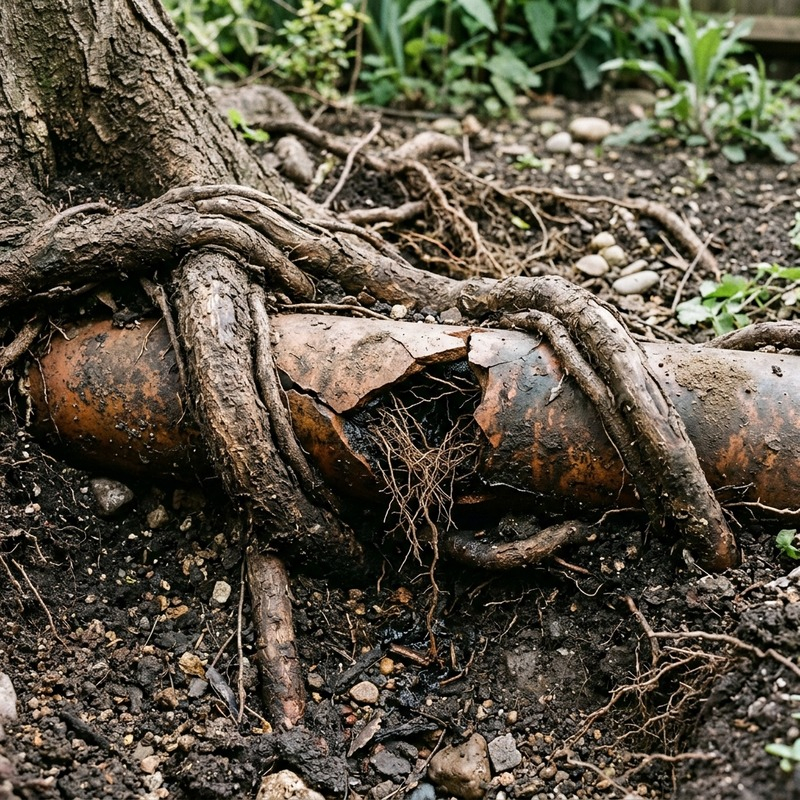
When I am asked about tree roots in pipes and who is responsible, my answer starts with two things: where the damaged section of pipe sits, and whose tree sent the roots into it. As a broad rule, a property owner looks after drainage on their own land, and the water authority looks after its own assets and the mains in the street. Who pays usually follows that division, though the picture shifts with the age and condition of the pipe, whether the tree is protected, and whether the pipe runs under a shared or easement area. I would want to know what is actually in the ground before anyone quotes repairs, and that is the sort of question an arborist can help you look at properly. This is general information rather than legal advice, so check your own circumstances with your council, your water authority and, if a dispute is forming, your own adviser.
Why roots end up in a pipe at all
Roots are not attacking your plumbing. They follow water, air and nutrients, and a slightly leaking drain offers all three. Vapour escaping from a small crack or loose joint creates a damp, oxygen-rich pocket in the soil, and fine root hairs grow towards it. Once a root hair finds the gap, it thickens, and a root that entered through a crack the width of a fingernail can become a woody mass that fills the pipe, catches solids and seals the line.
The sequence matters: in most cases the pipe had a fault first and the roots exploited it. Old earthenware drains with mortar joints, pipes that shifted as soil moved in dry weather, and poorly bedded sections are the usual starting points.
How the division of responsibility generally works
Drainage on a residential property is normally split into sections, and that split is where the question of who pays is usually settled. The pipework inside the boundary serving the house is ordinarily the owner’s to maintain, including branch lines from fixtures and the section running towards the connection point. Beyond that, the mains and the authority’s own infrastructure in the street are maintained by the water authority. Where that boundary sits varies between authorities, which is why the same blockage can be handled differently in two parts of Melbourne. Complications are common: older properties sometimes share a drain between several houses, some pipes run through an easement, and in strata properties common property drainage is usually the owners corporation’s responsibility.
The tree is the second half of the question. Where the roots came from a tree on the same property as the damaged pipe, the owner is generally dealing with both sides. Where they came from a neighbour’s tree, or a tree on council land, responsibility is worked out case by case, commonly turning on the pipe’s condition, whether anyone was on notice of a problem, and what was done about it. The facts decide it, which is why no article can tell you who is liable for your drain.
Finding out what is really going on
Guessing is expensive, so the work starts with evidence. Repeated slow drainage, gurgling, a smell, or wet ground over the line of a drain all point to a blockage, but none tell you the cause or location. A licensed plumber will usually clear the line first, then put a CCTV camera through it. The footage shows where the roots entered, how much pipe is involved, whether it is cracked, displaced or collapsed, and how far the damage runs. That recording is the most useful document you can have, because it establishes the pipe’s condition and the position of the fault, and both feed into any conversation about who fixes what. If the fault is beyond your section, give your water authority the footage. If it is inside your boundary, you know the scope before committing to a repair method.
Assess the tree at the same time. Its species, likely root spread, health and structural condition tell you whether it can stay with some management or will keep causing problems.
Dealing with the tree, and the root mass it leaves
Removing a tree does not remove its roots. The mass stays in the ground, and while it stops growing once the canopy is gone, the woody material remains, including any section inside a pipe, so the pipe repair still has to happen. If a tree does come out, the stump and root plate are the next decision. Leaving them means a slow decay that keeps ground soft, allows suckering on species that shoot from roots, and leaves an obstruction where you may later need to excavate for the drain. That is why grinding the remaining stump and root plate down below ground level is usually a second stage, leaving clear ground to work in.
Before any removal, check the tree’s status with your local council. Many Melbourne councils have local laws protecting significant trees and controls over native vegetation, so a tree causing drainage problems is not automatically one you may remove. Councils generally want an assessment and an application, and removing a protected tree without approval can carry penalties.
Where the tree can stay, management is the alternative: root barriers installed during pipe works, relining the drain with a jointless liner that gives roots nothing to enter, and keeping the tree in good condition.
When a root-damaged tree becomes a safety problem
There is a version of this problem that stops being about plumbing. Roots cut during excavation, or a root system compromised by long-term waterlogging around a leaking drain, can affect how well a tree stands up. Anchorage comes from the structural roots, so if a section has been severed or rotted, the tree can be less stable than it looks. Warning signs include a new or increasing lean, soil cracking or lifting in an arc on one side of the trunk, fungal brackets at the base, and recent trenching close to the trunk. A tree showing those after drainage works should be looked at promptly, because a green canopy says nothing about conditions underground. If a tree is leaning over a house, driveway or boundary and the ground around it is moving, that calls for an urgent response rather than a scheduled job, and in the meantime keep people and vehicles clear of the fall zone.
If a dispute is forming
Where a neighbour’s tree is involved, the practical path is usually the dull one. Put the facts in writing, share the camera footage, and ask for the issue to be addressed. Most of these matters resolve between the parties or their insurers once there is evidence rather than opinion.
If it does not resolve, your council is the first point of contact for tree-related local laws and trees on council land, and your water authority for anything involving its assets. Tell your insurer early too, because policies differ considerably in how they treat tree root damage. For a dispute heading further, get your own legal advice; nothing here is a substitute for it.
Straight away, gather the evidence, find out whether the tree is protected, and have it assessed. If you need the tree side looked at, The Yard can advise on the options. Get in touch here.
Frequently asked questions
Can tree roots get into PVC pipes? Yes, though it is less common than with old earthenware drains. PVC has fewer joints and a smoother bore, but roots can still enter through a cracked section, a joint that was not properly sealed, or a pipe damaged or shifted by excavation. The pattern is the same as with any pipe: roots find an existing fault rather than drilling through sound material.
Do you get free relief from a tree root? Not as a general rule. Clearing roots from a drain is ordinarily paid work, and the cost falls to whoever is responsible for that section of pipe. Where the fault is in the water authority’s own infrastructure, the authority typically handles that part, so have the line inspected and contact your authority before assuming the job is all yours.
In Australia, who is responsible if my tree falls on my neighbour’s house? This is decided on the facts, so it cannot be answered generally. Broadly it tends to turn on whether the tree owner knew, or should reasonably have known, that the tree was a hazard and failed to act, which is why documented inspections and acting on an arborist’s recommendations matter. In practice, these claims are usually handled between the two households’ insurers. Notify your insurer promptly, contact your council for anything involving local laws or a tree on council land, and get your own advice.
Who is responsible for tree root damage? It depends on where the damage is and whose tree caused it. The owner generally maintains private drainage within the boundary while the water authority maintains its own assets; shared drains, easements and strata common property each change the answer. Once the location is established by camera inspection, your council, water authority and insurer can tell you how it applies to your property. Treat this as general information only.