

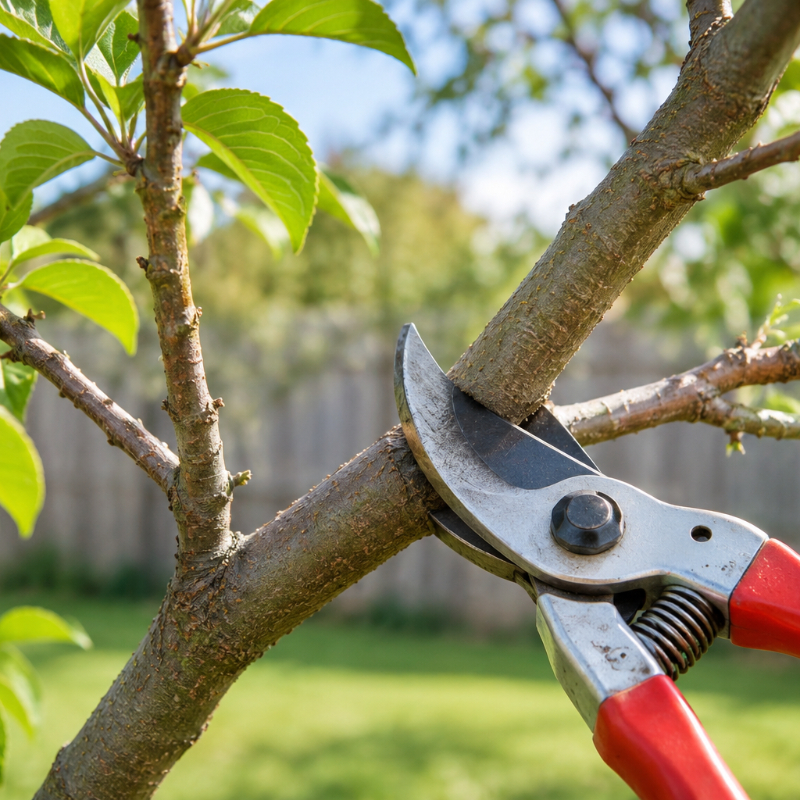
If you want to know how to prune fruit trees without losing next season’s crop, the short version is this: remove what is dead, damaged or growing into the middle of the tree, open the canopy so light and air can get to the fruiting wood, and then stop. Most of the backyard fruit trees I look at have not been under-pruned. They have been over-pruned, or pruned in the wrong spots, and the tree has answered with a mess of soft vertical growth that carries no fruit. Before you climb a ladder with the secateurs, it is worth seeing how a trained arborist approaches a pruning job, because the thinking matters more than the tool. Once you understand what each cut is doing, pruning your own apple, plum or citrus becomes a calm half hour rather than a guess.
What pruning is actually for
A fruit tree is not trying to feed you. It is trying to reproduce, and it will happily set more fruit than its branches can carry. Pruning is how you steer that. You are taking out wood that is dead or diseased, reducing the number of places the tree can put energy, letting sunlight reach the fruiting wood lower down, and keeping the tree at a height you can actually harvest and net.
Light is the one most people miss. Fruit colours and sugars up where the sun hits it. A canopy that has closed over the top shades everything beneath it, so the fruit sets high, out of reach, and the inner wood slowly goes unproductive. When an arborist talks about opening a tree up, that is the goal, not a tidier silhouette.
Five rules worth keeping in your head
Most pruning advice boils down to five working rules.
First, cut with a reason. If you cannot say what a cut is for, leave the branch alone. Second, take out the three Ds before anything else: dead, damaged and diseased wood. Third, remove branches that cross, rub or grow back into the centre, because those wounds are where rot gets in. Fourth, cut just outside the branch collar, the slightly swollen ring where the branch meets the trunk, and never flush with the trunk. Fifth, keep the total removed to roughly a quarter of the live canopy in one season, less on an older or stressed tree.
Those five will carry you through almost any backyard fruit tree. Everything else is refinement.
The cuts to make, in order
Work in a sequence so you do not stand back halfway through and find you have taken too much.
Start with the three Ds. Dead wood is brittle and often paler; scratch the bark with a thumbnail and look for green underneath. Cut back to healthy wood or to the collar.
Next, take out the structural problems: branches crossing through the centre, limbs rubbing against each other, and narrow forks where bark is being squeezed between two upright stems. Those forks split in a wind.
Third, deal with water shoots, the straight vertical whips that rise from the top of horizontal limbs. They rarely fruit and they shade everything below. Remove them at the base rather than shortening them, because a shortened whip simply sends up several more.
Last, shape. Shorten the leaders to an outward-facing bud so growth heads away from the centre, and thin the remaining fruiting wood so branches are not sitting on top of one another. Stand back every few cuts; pruning looks very different from two metres away.
Timing by fruit type, kept simple
Timing is where people get nervous, but the broad strokes are manageable. Pome fruit such as apples, pears and quinces are pruned while dormant, after leaf fall and before bud swell, when the structure is easiest to read. Stone fruit such as peaches, nectarines, plums, apricots and cherries are better pruned in the warmer, drier part of the year, because their wounds are vulnerable to fungal and bacterial infection in cold wet weather. Citrus gets a light tidy after the fruit comes off, lifting the skirt off the ground and clearing dead wood, and figs tolerate a harder cut while dormant.
Those are habits rather than hard dates, and Melbourne’s conditions shift the window from year to year. For the full picture by season, including the weeks to avoid, the detail is set out in this season-by-season look at pruning timing across the year rather than repeated here.
Where pruning stops, and trimming begins
These two words get used as if they mean the same thing, and the confusion leads to some poor outcomes on fruit trees. Pruning is selective. You are removing whole branches at a defined point for a horticultural reason, and the tree’s shape is a by-product of those decisions.
Trimming is about form and clearance. You are shortening growth across the outside of a canopy or hedge to a line, usually to keep it off a roof, a fence or a path. It is a legitimate job, and on hedges and screening plants it is exactly the right job, which is why shaping and clearance work is treated as its own kind of task. The problem comes when a fruit tree is trimmed like a hedge. Cutting every tip back to a line removes the fruiting wood and triggers dense regrowth at every cut point, which shades the interior and gives you a green ball with fruit only on the outside. On a fruit tree, choose selective pruning and accept that the result will look a little irregular.
Mistakes that cost you fruit
The expensive errors are consistent. Taking off too much in one session forces the tree into recovery growth instead of fruit. Shortening branches to a stub rather than cutting at a junction creates a cluster of weak shoots. Cutting flush with the trunk damages the collar, the tissue the tree uses to seal the wound. Leaving long stubs gives decay a doorway. Pruning stone fruit in cold, wet conditions invites infection into every fresh cut.
Tools matter too. Blunt secateurs crush rather than cut, and a crushed cut heals slowly. Sharpen before you start, and wipe the blades with methylated spirits between trees if anything looks diseased. Wound dressings and sealants are not needed; a clean cut at the collar works better than paint.
Know when to stop and call someone
There is a point where backyard pruning stops being sensible. If the work needs you above comfortable ladder height, if the limbs are big enough that a falling piece could hurt you or land on a fence, roof or power service, or if the tree has splits, cavities or lifting at the base, that is a job for an arborist with the right gear and insurance. The same applies if the tree is protected, because many Melbourne councils have controls over significant trees and native vegetation. Your council is the right place to confirm what applies at your address before any cutting starts.
For everything inside those limits, a sharp pair of secateurs, a small pruning saw, and the five rules above will get you a healthier tree and better fruit. If the pruning you are looking at is beyond that, the team at The Yard can take a look and sort it out properly. Get in touch here.
Frequently asked questions
How do I prune fruit trees in Australia? Match the method to the fruit group. Apples, pears and quinces are pruned while dormant; stone fruit such as peaches, plums and apricots are better pruned in warmer, drier weather to reduce infection risk; citrus gets a light tidy after harvest. In all cases, remove dead, damaged and diseased wood first, then crossing and inward-growing branches, then vertical water shoots, and finish with light shaping.
What are the five rules of pruning? Cut with a clear reason; remove dead, damaged and diseased wood before anything else; take out branches that cross, rub or grow inward; cut just outside the branch collar rather than flush or leaving a stub; and keep the total removed to about a quarter of the live canopy in one season.
What is the best way to prune fruit trees? Work in order rather than wandering around the tree. Clear the three Ds, fix the structural problems, remove water shoots at their base, then thin and shorten what is left to an outward-facing bud. Step back every few cuts to check the balance, and use sharp, clean tools so each wound can seal.
What are the common mistakes when pruning? Removing too much at once, cutting to a stub instead of a junction, cutting flush with the trunk and damaging the collar, shearing a fruit tree to a line as if it were a hedge, pruning stone fruit in cold, wet conditions, and working with blunt or dirty blades.