

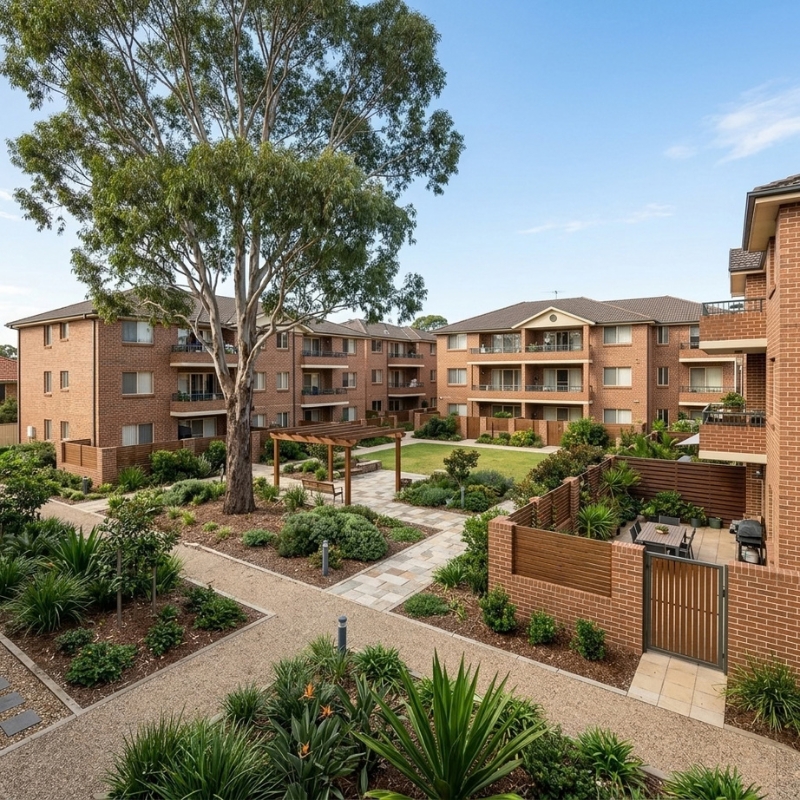
When a tree on a strata or commercial property drops a limb, blocks light, or needs removing, the first question is always the same: whose job is it to deal with it? The answer is rarely as simple as “the owners corporation” or “the individual owner”, because it depends on where the tree actually sits and what the property’s own documents say. This article explains how responsibility for trees on strata and commercial property is generally worked out, what duty of care means in this context, and how to get tree work approved through a committee without it dragging on. It is general information to help you understand the landscape, not legal advice, so for your specific situation your plan of subdivision and your strata manager are the authorities to rely on.
How responsibility is generally decided
The starting point for working out who is responsible for a tree is where the tree is located within the property, specifically whether it sits on common property or on a lot. That distinction is what most responsibility questions come back to.
In general terms, trees growing on common property, the shared areas of a strata scheme, are typically the responsibility of the owners corporation, because the owners corporation looks after common property on behalf of all the owners. Trees growing within an individual lot, the part of the property an owner owns outright, are more often the responsibility of that individual owner. That is the broad principle, but it is only ever a starting point, because the precise boundaries of common property and lots are not something you can judge by eye.
Where the line actually falls is set out in the property’s plan of subdivision, the document that defines what is common property and what belongs to each lot. A tree that looks like it is in a courtyard belonging to one unit might sit on common property, or the reverse, and only the plan of subdivision tells you for certain. This is why the honest answer to “who is responsible” always routes back to the same two places: your plan of subdivision for the boundaries, and your strata manager to help interpret how responsibility is allocated in your particular scheme. Those are specific to your property in a way no general article can be.
What duty of care means here
Alongside the question of who owns or manages a tree sits the idea of duty of care, which is worth understanding in plain terms. Broadly, whoever is responsible for a tree has a general responsibility to take reasonable care that it does not cause foreseeable harm to people or property. A tree is a living thing that grows, ages and can develop faults, so looking after it reasonably is part of being responsible for it.
In practice, this points towards keeping an eye on the trees you are responsible for, acting on obvious problems such as a visibly dead, damaged or unstable tree rather than ignoring them, and getting things assessed when there is reason to be concerned. The idea is reasonable, proactive care rather than waiting for something to go wrong. What counts as reasonable depends on the circumstances, and I want to be clear that this is a general description of the concept, not a statement of what any particular party is legally obliged to do in a given situation. For that, professional advice specific to your circumstances is the right path.
The practical takeaway is that responsibility for a tree is not purely passive ownership, it generally comes with an expectation of reasonable upkeep, which is another reason it matters to be clear about who is responsible in the first place.
Getting tree work approved through a committee
On a strata property, even once you know a tree needs attention, there is usually a second hurdle: getting the work approved. Tree work on common property generally needs to go through the owners corporation or its committee rather than being arranged by one owner acting alone, and that process can be where things stall.
A few things tend to make approval smoother:
- Take it to the right people. Raise the tree with your strata manager or the committee rather than organising work yourself, since work on common property is a collective decision.
- Bring evidence, not just an opinion. A clear assessment of the tree’s condition and what it needs carries far more weight with a committee than “I think that tree is a problem”, and helps the decision get made rather than deferred.
- Separate urgent from routine. A tree that poses an immediate safety risk is a different conversation from general maintenance, and flagging which one it is helps the committee prioritise appropriately.
- Get a professional quote and scope. A committee can approve work much more readily when there is a clear scope and quote in front of it, so it knows exactly what it is agreeing to.
The common thread is that committees approve work they understand and trust. A professional assessment and a clear scope of works turn a vague concern into a decision the committee can actually make. For larger strata and commercial properties, commercial tree removal handled by a specialist who can provide that assessment and scope is often what gets the job over the line, because it gives the committee the documented basis it needs.
Common property, courtyards and the grey areas
The trickiest tree questions on strata property usually involve the in-between cases, and it is worth naming them so you know to check carefully. A tree in a courtyard attached to a single unit, for instance, raises the question of whether that courtyard is part of the owner’s lot or is common property that the owner has exclusive use of, which are different things with potentially different responsibility. A tree whose trunk sits in one area but whose roots or canopy extend into another is another classic grey area.
In all of these, the instinct to reason it out from what seems fair or obvious is exactly what leads people astray, because responsibility follows the formal boundaries and the scheme’s arrangements rather than appearances. The plan of subdivision and the strata manager are, once again, where these grey areas get resolved for your specific property. If a tree sits anywhere near a boundary between lot and common property, or involves exclusive-use areas, that is a signal to check rather than assume.
Working it out for your property
Pulling it together, the sensible approach is to establish the facts in order. First, find out where the tree actually sits by checking the plan of subdivision, rather than judging by appearance. Second, confirm with your strata manager how responsibility is allocated for that tree in your scheme. Third, if work is needed, take it through the owners corporation or committee with a professional assessment and a clear scope so it can be approved properly. And throughout, treat the reasonable-care expectation as a reason to deal with obvious tree problems rather than leave them.
Doing it in that order keeps a tree issue from turning into a dispute between owners or a delayed decision, because everyone is working from the same clear basis of who is responsible and what needs doing.
Frequently Asked Questions
Is the owners corporation responsible for all trees on a strata property?
Not necessarily. As a general principle, the owners corporation tends to be responsible for trees on common property, while trees within an individual lot are more often the owner’s responsibility. Where the boundary falls is set by the plan of subdivision, so check that and your strata manager.
How do I find out if a tree is on common property or my lot?
The plan of subdivision for your strata scheme defines what is common property and what belongs to each lot. It is the document that settles the question, and your strata manager can help you interpret it, since appearances alone do not reliably tell you where a tree sits.
Who approves tree work on common property?
Work on common property generally needs to go through the owners corporation or its committee rather than being arranged by an individual owner. Bringing a professional assessment and a clear scope of works makes it easier for the committee to approve the work.
What does duty of care mean for trees?
In general terms, whoever is responsible for a tree is expected to take reasonable care that it does not cause foreseeable harm, which points to monitoring and acting on obvious problems. This is a general description of the concept, not legal advice, so seek professional advice for your situation.
Knowing who is responsible
Responsibility for a tree on a strata or commercial property comes down to where the tree sits, common property or an individual lot, and that is determined by the plan of subdivision rather than by appearance, with the owners corporation and strata manager allocating it from there. Reasonable care comes with that responsibility, and work on common property goes through the committee. Because every scheme is different, your plan of subdivision and strata manager are the authorities for your specific case. If you need a tree on a strata or commercial property assessed and the work scoped for your committee, contact The Yard, Unit 2/42 Ravenhall Way, Ravenhall VIC 3023, on 0450 410 800.