

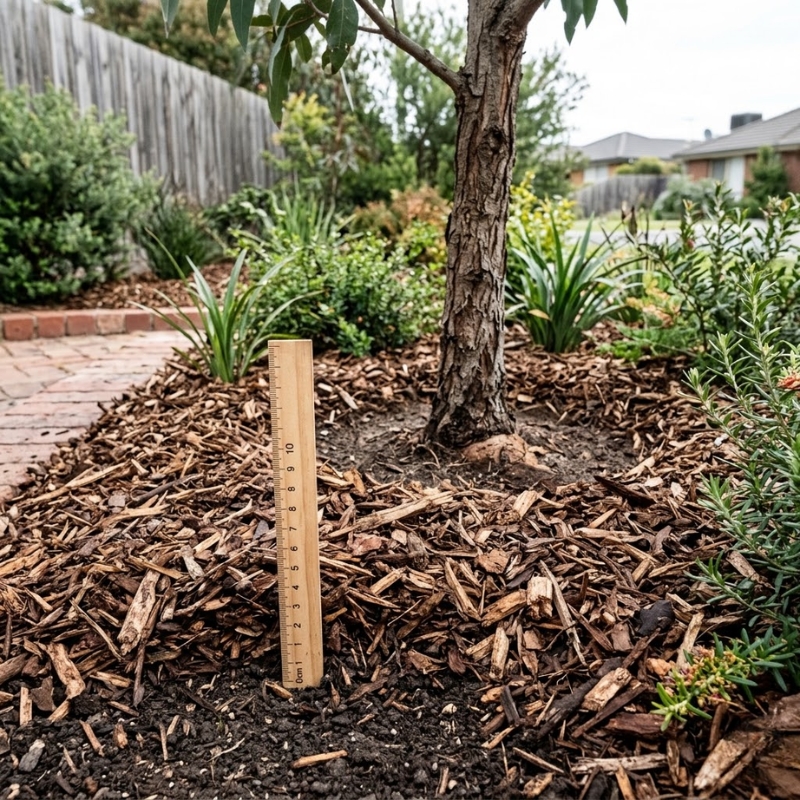
Mulch is one of the best “set-and-forget” tools in a Melbourne garden. Done well, it helps hold moisture through summer, smooths out soil temperature swings, and suppresses weeds without chemicals.
Done badly, mulch can cause the exact problems you were trying to prevent:
• waterlogging and sour smells in garden beds
• fungal mats and slimy mulch that won’t dry
• plants that look thirsty even though the soil is wet
• collar rot on shrubs and trees (damage at the base of the stem/trunk)
• shallow roots and stressed plants that struggle in heat or wind
The good news is that over-mulching is easy to spot and easy to fix — once you know what you’re looking for and how mulch behaves in real-world conditions (especially Melbourne’s mix of hot spells, heavy downpours, and clay-heavy soils in many suburbs).
This guide explains safe mulch depths, what “too much” looks like, why it causes problems, and how to correct it without ripping your whole garden apart.
The short answer: what depth is usually safe?
Most gardens do well with a mulch layer that’s thick enough to block light (for weeds) but thin enough to let air and water move through.
A practical rule of thumb:
• Garden beds: about 5–7 cm
• Around established trees: about 5–8 cm, kept well away from the trunk
• New plants or tight clay soils: start closer to 3–5 cm and build up gradually if drainage is good
The real “too much” zone starts when mulch becomes a moisture trap and airflow blocker — especially when it’s piled against stems or trunks.
Q&A: Can too much mulch actually kill a tree?
Yes. The most common pathway is collar rot or chronic moisture stress. Mulch piled against a trunk holds moisture where bark needs to breathe, encourages decay organisms, and can stress roots by reducing oxygen exchange. It’s also common for pests to shelter in thick, damp mulch right up against the base.
Why too much mulch causes root rot and “suffocating soil”
Mulch itself isn’t the enemy. The problem is what happens when it’s too deep or packed too tightly:
• Less oxygen reaches the soil (roots need oxygen, not just water)
• Water lingers longer after rain or irrigation, especially on clay soils
• The stem/trunk stays damp when mulch touches it
• Microbial activity changes (more anaerobic conditions = sour smell, slime, rot risk)
• Fine mulch can “seal” the surface and shed water sideways instead of letting it soak in
In Melbourne, this gets amplified in two situations:
• wet winter periods where soils stay damp for weeks
• sudden summer downpours where heavy rain saturates beds, fast and deep mulch slows drying
The #1 mistake: “mulch volcanoes” around trees
If you only fix one mulching habit, fix this.
A “mulch volcano” is when mulch is piled up into a cone against the trunk. It looks neat. It’s also one of the quickest ways to create long-term tree stress.
What goes wrong:
• the trunk stays damp
• bark can soften and decay
• roots may shift upward toward the surface
• the tree becomes more vulnerable to pests and disease
• you can end up with instability over time (shallower rooting)
What to do instead:
• form a flat doughnut or “tree bowl” shape
• keep a clear mulch-free ring around the trunk (think: you should see the trunk flare)
• spread mulch outward to the dripline if possible, rather than piling it high at the base
If you want a simple reference you can send to anyone helping in the garden, keep this as your baseline mulch depth guide.
Signs you’ve over-mulched (what you’ll see and smell)
Over-mulching has a consistent set of warning signs. Use this list as your quick diagnostic.
Soil and mulch signs
• mulch feels spongy, slimy, or matted
• a sour / swampy smell when you lift the mulch
• visible white fungal threads forming a dense mat
• water sits on top and runs sideways instead of soaking in
• mulch layer is thicker than your fingers can comfortably measure (10 cm+ is often trouble in many beds)
Plant signs
• wilting even though the soil is wet (roots aren’t functioning well)
• yellowing leaves or slow growth
• new growth that’s weak and soft
• plants that look “hungry” even though you fertilise (root stress reduces uptake)
• shrubs and trees showing dieback near the base
Tree and shrub base signs (important)
• mulch touching stems/trunks
• dark, soft bark near the base
• fungal growth at the collar
• ants, slaters, or other pests sheltering under heavy mulch right against the plant
Q&A: Is fungus in mulch always bad?
Not always. Some fungal activity is normal and part of decomposition. The red flags are thick mats, slime, sour smells, and constant dampness, especially right against stems/trunks.
How deep is “too deep” in Melbourne gardens?
Depth isn’t just a number. It depends on what’s underneath and what you’re mulching around.
When 8–10 cm might be too much
• heavy or compacted clay soils
• shaded beds that dry slowly
• low-lying areas where water pools
• around shrubs with stems close to the ground
• around trees where mulch is drifting toward the trunk over time
• where mulch is very fine and packs down tight
When a slightly thicker layer can be OK
• sandy or free-draining soils
• sunny, exposed beds that dry quickly
• coarse chunky mulch that lets air move through
• wide beds away from stems/trunks, with good drainage
The safest approach is simple:
• start moderate
• check after the first heavy rain
• adjust if the bed stays wet and sour underneath
Mulch type matters: chunky vs fine (and why it affects “suffocating”)
Mulch behaves differently depending on particle size.
Chunky woodchip / bark
• better airflow
• tends to settle less into a tight mat
• often safer at slightly thicker layers
• can still cause collar issues if piled against trunks
Fine shredded mulch
• can look tidy fast
• often compacts into a dense layer
• more likely to shed water if it dries out then rewets
• easier to overdo on clay soils
If you’re seeing water run off rather than soak in, fine mulch and too much depth are common culprits.
Melbourne soil reality: clay changes everything
A lot of Melbourne suburbs have soils with significant clay content. Clay isn’t “bad” — it’s nutrient-holding and can grow great plants — but it drains differently.
Clay + too much mulch can lead to:
• slow drying after rain
• anaerobic (low oxygen) conditions under the mulch
• roots sitting wet for too long
If your soil stays wet a day or two after rain (under mulch), reduce depth and consider improving structure over time (compost worked into soil, better grading, drainage fixes where needed).
How to fix over-mulching quickly (without starting again)
You don’t need to remove all mulch. You need to change how it sits.
Step 1: Pull mulch away from stems and trunks immediately
This is the fastest win.
• create a clear ring around every tree and shrub
• remove wet mulch that’s stuck to the base
• let the collar area dry out
Step 2: Reduce depth in problem spots
Target the areas that stay wet:
• shaded corners
• low points
• tight beds near fences
• around delicate plants
Aim for:
• 3–5 cm in damp-prone spots
• 5–7 cm in average beds
• 5–8 cm around established trees, but never against the trunk
Step 3: Loosen compacted mulch
If mulch has formed a mat:
• lightly rake the top to break the crust
• remove any slimy layers
• avoid turning mulch into the soil (especially if it’s sour)
Step 4: Check drainage, not just mulch
If water is pooling:
• check downpipes and overflow points
• improve grading so beds don’t become basins
• consider a simple drainage channel or redirecting runoff
Q&A: Should I remove mulch if I suspect root rot?
Start by clearing mulch away from the base, reducing depth, and improving drying/airflow. If a plant is already collapsing, you may need a deeper diagnosis. But most “early stage” mulch stress improves fast once the collar dries and oxygen returns.
How to calculate how much mulch you need (and avoid over-ordering)
Over-mulching often happens because people order a big load and feel like it needs to go somewhere. It doesn’t. Excess mulch can be stored for top-ups.
The simple volume formula
• Volume (m³) = Area (m²) × Depth (m)
Examples:
• 10 m² bed at 5 cm (0.05 m) = 0.5 m³
• 20 m² bed at 7 cm (0.07 m) = 1.4 m³
• 50 m² area at 5 cm (0.05 m) = 2.5 m³
If you’re unsure of your drainage, choose the lower depth first — you can always top up later.
A practical top-up strategy
Instead of re-mulching thick every time:
• refresh with a thin top-up (1–3 cm) when the old layer breaks down
• keep stems and trunks clear each time
• rake lightly before topping up so you don’t build a sealed layer
If you want a simple routine that prevents the “volcano” problem and the wet-mat problem, focus on how to avoid over-mulching as your non-negotiable: moderate depth, clear collars, and adjust for drainage.
Mulch around trees: how to do it safely (especially near structures)
Mulch is great for trees when it’s used properly:
• reduces lawn competition
• stabilises soil temperature
• helps moisture retention during heat
But trees also interact with infrastructure — paths, pipes, drains, and foundations. If you’re planting or managing trees near easements or water assets, Melbourne Water has specific guidance on planting near sewers, drains, waterways and water mains and the approvals process where required. It’s worth checking their rules before you change planting in sensitive areas: Melbourne Water planting guidelines.
The safe tree-mulch layout
• keep mulch away from the trunk flare
• extend mulch outward (a wide ring beats a tall pile)
• keep depth consistent and moderate
• avoid burying visible surface roots under heavy layers
If you’re working around established trees and want to keep it simple and safe, use this as your default: mulching around trees safely (wide and flat, not high and tight).
Common “too much mulch” scenarios (and what to do)
Scenario 1: You mulched thick before winter, and now it’s always damp
What’s happening:
• reduced evaporation + slow winter drying + clay = persistent wet
Fix:
• reduce depth to 3–5 cm in shady/wet zones
• rake to loosen
• clear collars
• improve airflow (trim dense groundcovers that trap moisture)
Scenario 2: Your mulch is full of fungus and smells sour
What’s happening:
• anaerobic conditions under a compacted layer
Fix:
• remove slimy or matted sections
• break the crust and thin the layer
• avoid overwatering
• consider switching to chunkier mulch next time
Scenario 3: Plants look thirsty, but the soil is wet
What’s happening:
• oxygen-poor roots can’t function properly
Fix:
• reduce mulch thickness
• check irrigation frequency
• ensure water is soaking in (not running sideways)
• let beds dry slightly between watering
Scenario 4: Mulch keeps sliding onto trunks
What’s happening:
• the bed is shaped like a bowl, or mulch was piled too steeply
Fix:
• re-grade mulch into a flat ring
• install a subtle edging line (not pressed hard to trunk)
• check after heavy rain and pull back as needed
Q&A blocks: the questions people ask right before they mulch
Is 10 cm of mulch too much?
Often, yes — especially in Melbourne clay soils, shaded beds, or near stems/trunks. If you want weed suppression, aim for 5–7 cm and keep it off collars. If the bed stays damp underneath, go thinner.
Should mulch touch the trunk?
No. Keep mulch off the trunk and visible root flare. Touching trunks is a common cause of collar rot and pest harbouring.
How often should I top up mulch?
Usually, when the layer breaks down and stops suppressing weeds or holding moisture — often happens once a year or every 12–18 months, depending on mulch type and exposure. Top up thinly rather than re-laying thick.
Can mulch cause termites?
Mulch can provide shelter and moisture, but termites are primarily about broader conditions and access to timber. The practical move is to keep mulch off structures, avoid piling against timber, and maintain clear inspection zones around buildings.
Is mulch better than compost?
They do different jobs. Mulch is a surface blanket for moisture and weeds. Compost is a soil amendment to improve structure and nutrients. Many gardens benefit from compost worked into the soil (where appropriate) and mulch on top.
The “do this, not that” mulching checklist
Do this:
• keep mulch 5–7 cm in most beds
• go thinner (3–5 cm) in shaded, wet, or clay-prone zones
• keep a mulch-free ring around trunks and stems
• use wide, flat mulch rings around trees
• check after heavy rain and adjust
Not that:
• don’t pile mulch against trunks (“volcano”)
• don’t keep adding without raking and checking the old layer
• don’t compact mulch down like a carpet
• don’t try to fix drainage issues with extra mulch
Final FAQ
How do I know if my soil is being “suffocated” by mulch?
If it smells sour, stays wet for days, or forms a slimy mat underneath, oxygen exchange is likely poor. Reduce depth, loosen the layer, and check drainage.
What’s the best mulch depth for weed control without causing rot?
In most garden beds, 5–7 cm is a strong balance. The big rot risk is mulch against stems/trunks and overly deep layers on slow-draining soils.
Can I put mulch over existing mulch?
Yes, but only after you:
• rake and loosen the old layer
• remove matted/slimy sections
• confirm you’re not burying stems or trunks
• keep total depth in a safe range
Why is water running off my mulch instead of soaking in?
This can happen if mulch is too fine, too thick, compacted, or has dried out and become water-repellent. Break the crust, thin the layer, and water slowly to re-wet it.
What should I do if I have already built mulch volcanoes around trees?
Pull mulch back immediately, expose the trunk flare, and reduce depth near the base. Keep the ring clear and monitor for soft bark or decay signs.