
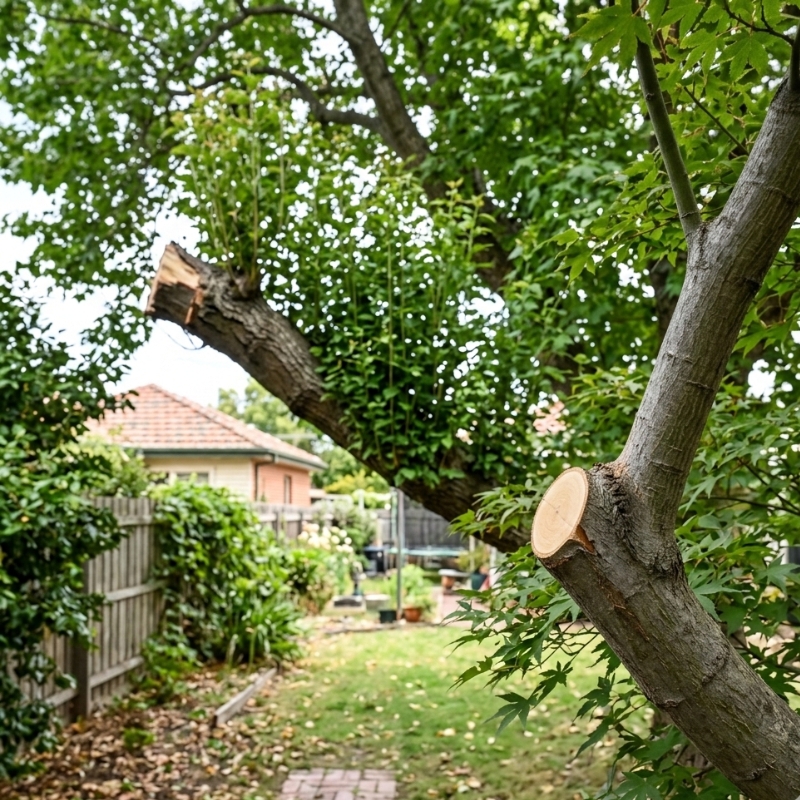
Most people don’t set out to harm a tree — they’re trying to tidy it up, let in light, or keep branches away from gutters. But the wrong cut in the wrong place can kick off a chain reaction: weak regrowth, sunburnt limbs, decay pockets, and a canopy that becomes more hazardous over time. If you’ve ever wondered why a tree looks worse after tree pruning, this guide will help you spot the most common cutting mistakes and choose safer alternatives that support long-term health in Melbourne conditions.
Why “bad cuts” are such a big deal
Trees don’t heal as we do. They don’t “repair” damaged wood — they manage it. When you cut, you’re creating an opening where pests, disease, and decay organisms can enter. A good cut is one that the tree can defend and compartmentalise quickly. A bad cut is one that leaves tissue exposed, traps moisture, or forces the tree into frantic, weak regrowth to survive.
In Melbourne, this matters even more because:
• Sudden heat can stress freshly exposed limbs (especially on trees that were previously shaded)
• Winter storms and spring winds can exploit weak attachments created by poor regrowth
• Many common garden trees (including several natives) respond to harsh cutting with dense epicormic shoots that are fast-growing but structurally weaker
Mistake 1: Tree topping (and why it backfires)
Topping is when the top of a tree is cut off to reduce height — usually by making large cuts through major limbs or the central leader, leaving blunt stubs. It’s one of the fastest ways to shorten a tree’s life.
What happens next:
• The tree panics and pushes out lots of shoots near the cuts
• Those shoots attach to the outer layers of wood rather than forming strong, well-integrated branch unions
• The regrowth becomes heavy quickly, creating a higher failure risk during wind events
• Large wounds are slow to heal, increasing decay and hollowing over time
Better alternative:
• If height reduction is genuinely needed, look into a staged crown reduction that respects the tree’s structure (smaller cuts, reducing end-weight on selected limbs) rather than removing the top wholesale.
Q: How can I tell if my tree has been topped?
If you see flat “cut points” high in the canopy, multiple thick stubs, and a cluster of long, whippy shoots growing straight up from those cuts, topping is likely. A natural canopy has tapered branch lines and varied, outward growth — not broom-like bunches.
Mistake 2: Flush cuts (cutting too close to the trunk)
A flush cut removes the branch collar — the slightly swollen area where the branch meets the trunk (or a larger limb). That collar contains tissue that helps the tree seal the wound.
Why it’s harmful:
• Removing the collar makes the wound larger than it needs to be
• It reduces the tree’s ability to defend against decay
• It often leads to sunken, rotten wounds that expand over time
What to do instead:
• Aim to cut just outside the branch collar, without leaving a stub and without slicing into the trunk. If you’re unsure, make a smaller, conservative cut and reassess rather than cutting closer “to make it neat”.
Q: What’s the branch collar, in plain English?
It’s the tree’s built-in “boundary zone” where branch tissue meets trunk tissue. Preserving it helps the tree close off the cut more effectively.
Mistake 3: Leaving stubs (cutting too far from the trunk)
Stubs happen when you cut a branch but leave a length of dead wood sticking out, often because you’re trying not to damage the trunk — or you’re cutting from a ladder and can’t reach the right spot.
Why it’s harmful:
• Stubs don’t have the same defence tissue and often die back
• They can become entry points for decay
• They can encourage weak, poorly attached sprouts near the stub
What to do instead:
• Find the branch collar and cut just outside it. For heavier limbs, use a proper method (see Mistake 6) so the bark doesn’t tear.
Mistake 4: Over-pruning (removing too much at once)
Taking “a bit more” can be tempting, especially if you’re chasing sunlight, views, or a cleaner look. But removing too much canopy in one go can seriously stress a tree.
Common consequences:
• Sunburn on suddenly exposed limbs (a real risk in hot Melbourne spells)
• A surge of epicormic shoots (dense, fast regrowth that can become a maintenance headache)
• Reduced energy reserves and slower recovery
• Greater susceptibility to pests and disease
A safer rule of thumb:
• For many established trees, avoid removing a big chunk of live canopy in one session. If the tree needs meaningful change, a staged approach is often kinder and safer.
Q: Why did my tree explode with shoots after I cut it back?
That’s often the tree trying to rebuild leaf area quickly. Those shoots can be weakly attached and crowded, so they can become a long-term structure problem if not managed carefully.
Mistake 5: Lion-tailing (stripping inner growth and leaving tufts)
Lion-tailing is when you remove most of the inner branches and foliage, leaving leaves only at the ends of long limbs. It can look tidy… until the wind hits.
Why it’s risky:
• It shifts weight to the ends of branches (more leverage, more breakage risk)
• It exposes the inner bark and limbs to the sun and heat
• It can reduce the tree’s ability to dampen wind movement through the canopy
Better alternative:
• If the goal is airflow or light, focus on selective thinning that maintains foliage distribution along the limb — not just at the tips.
Mistake 6: Ripping bark with heavy limb cuts
If you cut a heavy limb straight through from the top, the branch can peel down as it falls, ripping bark and wood along the trunk. That tear can be far more damaging than the branch you removed.
What to do instead (the safer sequence):
• Make a small undercut a short distance from the trunk (prevents tearing)
• Make a top cut further out to remove the limb’s weight
• Make the final cut just outside the branch collar to finish cleanly
If you’re not confident doing this safely, that’s a strong sign you should get help with tree pruning rather than risking a major wound (or a fall).
Mistake 7: Cutting at the wrong time for the goal
Timing isn’t just about “winter is best” or “never prune in summer”. The best timing depends on what you’re trying to achieve and how the tree responds to stress.
In Melbourne, practical considerations include:
• Heatwaves: heavy cutting just before or during extreme heat can increase stress and sun exposure
• Storm season patterns: reducing end-weight on vulnerable limbs before windy months can reduce risk, but only if done correctly
• Flowering/fruiting cycles: some ornamentals and fruit trees have better windows to preserve flowers or manage growth
A simple approach:
• Light deadwood removal is often less time-sensitive
• Significant canopy changes are best planned around tree health, weather, and recovery capacity
Q: Is it ever okay to prune in summer?
Sometimes, yes — especially for small, targeted cuts. The risk increases when you remove lots of foliage, expose bark suddenly, or prune a stressed tree during hot, dry periods.
Mistake 8: Using blunt or dirty tools
A blunt blade crushes tissue rather than slicing it cleanly, which can slow wound closure. Dirty tools can also spread problems between plants.
Do this instead:
• Sharpen secateurs and saws so cuts are clean
• Clean tools between trees (and especially between diseased and healthy material)
• Use the right tool size so you’re not twisting or tearing wood
Mistake 9: “Wound paint” and sealing cuts
It feels logical to “seal” a cut like a bandage. But many sealants can trap moisture or interfere with the tree’s natural defence processes.
A better approach:
• Focus on making a correct cut in the right place and letting the tree manage the wound naturally
• Support recovery with sensible aftercare (mulch where appropriate, avoid damaging roots, and keep an eye on water during hot spells)
Mistake 10: Chasing clearance without respecting structure
Cutting branches back to random points to clear a roofline, fence, or driveway often creates awkward stubs and stimulates weak regrowth. You can end up with a tree that needs more frequent cutting — and becomes less stable each time.
Better alternatives:
• Use reduction cuts back to suitable laterals (smaller side branches that can take over as the new end point)
• Consider staged reductions rather than one big hack-back
• If a tree is fundamentally the wrong size for the location, it may need a long-term plan rather than repeated harsh cutting
If you’re unsure how to do this safely, safe tree pruning is less about cutting “more” and more about choosing fewer, better cuts that the tree can handle.
A quick “good cut vs bad cut” checklist you can use
Look for these signs after any cutting:
• Cuts are just outside the branch collar (not flush, not stubby)
• No torn bark down the trunk
• Canopy still has foliage distributed along limbs (not only at the ends)
• No large, flat-topped stubs high in the canopy
• The tree still has a balanced shape, not a lopsided “one-side removed” look
For Victorian guidance around responsibilities and when to check local protections before cutting, see the Victorian Government’s overview on Trees in Victoria.
When DIY stops being worth it
Some mistakes happen because the job is physically difficult, not because the person doesn’t care. The risk jumps quickly when:
• The branch is heavy enough to tear bark if it falls unexpectedly
• You’re working above shoulder height, on a ladder, or near structures
• There are targets underneath (cars, roofs, fences, footpaths)
• The tree has visible cracks, including bark unions, or dead tops
• Powerlines are involved (always treat this as a specialist scenario)
At that point, the safest move is to get professional tree pruning in Melbourne so cuts are made in a way that supports both structure and recovery.
Q: What’s the biggest “red flag” that a cut will go wrong?
If you can’t control where the branch will go when it releases — because of weight, height, or awkward angles — the chance of tearing bark or hitting something valuable is high.
What to do if your tree has already been cut the wrong way
If you’re dealing with topping, stubs, or heavy over-pruning, the goal is to stabilise and guide recovery — not “fix it” with more aggressive cutting right away.
Practical next steps:
• Don’t keep hacking off the new shoots without a plan (it can make the cycle worse)
• Watch for crowded, weakly attached shoots and consider staged selection over time
• Check for signs of decay around large wounds (soft wood, cavities, fungal growth)
• Reduce stress: protect roots from compaction, maintain mulch (not against the trunk), and keep water consistent during dry stretches
• If there are large wounds or structural concerns, get an assessment before the next windy season
Q: Can a topped tree be saved?
Sometimes. Some trees tolerate harsh cutting better than others, but topping always increases long-term risk. A staged, structural approach can improve outcomes, but there’s no undo button — the earlier you shift to better management, the better the odds.
FAQ
How much can I cut off a tree without harming it?
It depends on species, age, health, and the season. As a general principle, avoid large one-off removals of live canopy. If meaningful reduction is needed, staged pruning is often safer than one heavy session.
What’s worse: flush cuts or stubs?
Both are problematic in different ways. Flush cuts remove the branch collar and can increase decay risk. Stubs can die back and become decay entry points. The aim is a clean cut just outside the collar.
Why do my cuts keep producing lots of thin vertical shoots?
That’s often a stress response, especially after heavy cutting or topping. Those shoots can grow fast but attach weakly, so they need thoughtful management rather than repeated blunt removal.
Should I seal pruning cuts with paint?
Usually, the better focus is correct cut placement and clean technique. Many sealants can trap moisture or interfere with natural defence processes.
How do I know if a branch is dangerous?
Warning signs include cracks, a sudden lean, dead sections, hanging branches, and unions with included bark. If the limb is large or above a target (roof, driveway, footpath), treat it as higher risk.
What’s the safest way to remove a heavy limb?
Use the undercut–top cut–final cut sequence to prevent bark tearing. If you can’t do it from stable ground with control over the fall path, it’s time to bring in a qualified professional.