

Tree Removal Burnside
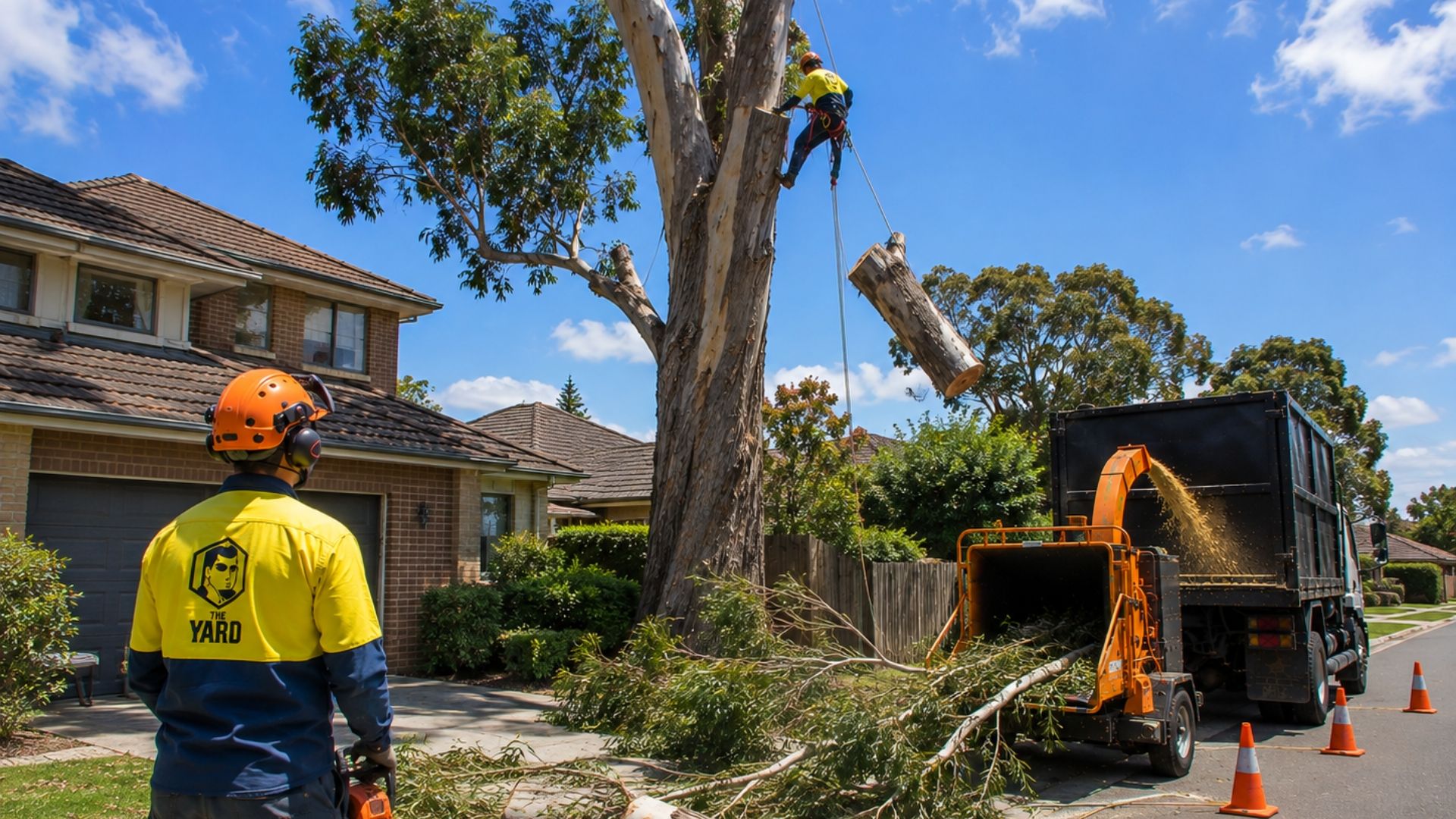
Burnside blocks are newer, tighter and fenced on every side, so taking a tree out here is usually a climbing and rigging job rather than a straight fell. Our crews run out of Ravenhall, a few minutes up the road, and dismantle gums, pears and robinias in sections over pools, pergolas and shared boundary fences.
Get your Burnside quote
Send the street, the tree and what is around it, and we will put the figure and the scope in writing before anything is booked.
Tree removal in Burnside: what the job looks like on a 3023 block
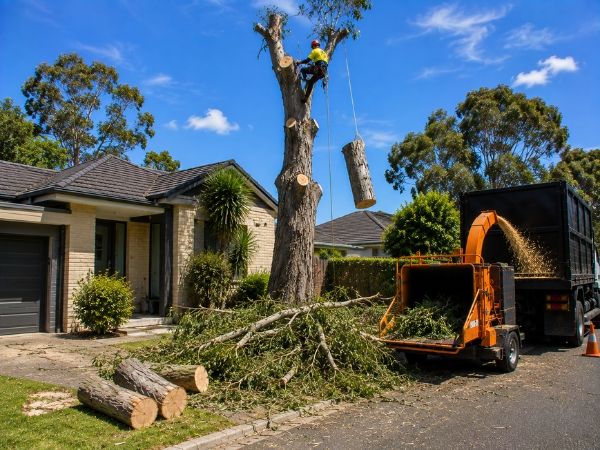
On a typical Burnside block the tree comes down in pieces, not in one drop. A climber sets a rope, cuts the canopy back limb by limb, lowers each section into a small landing area near the house, then takes the stem down in short rounds while a ground crew feeds the chipper at the kerb.
Most of Burnside was built as estate housing on compact lots, which means the mature trees are now close to roof lines, Colorbond fences, pool fencing and the neighbour's pergola. There is rarely a drop zone wide enough to fell a whole stem safely, so the sensible method is controlled dismantling with ropes and lowering devices. It is slower than felling, and that time is the main reason two trees of the same height can be quoted differently.
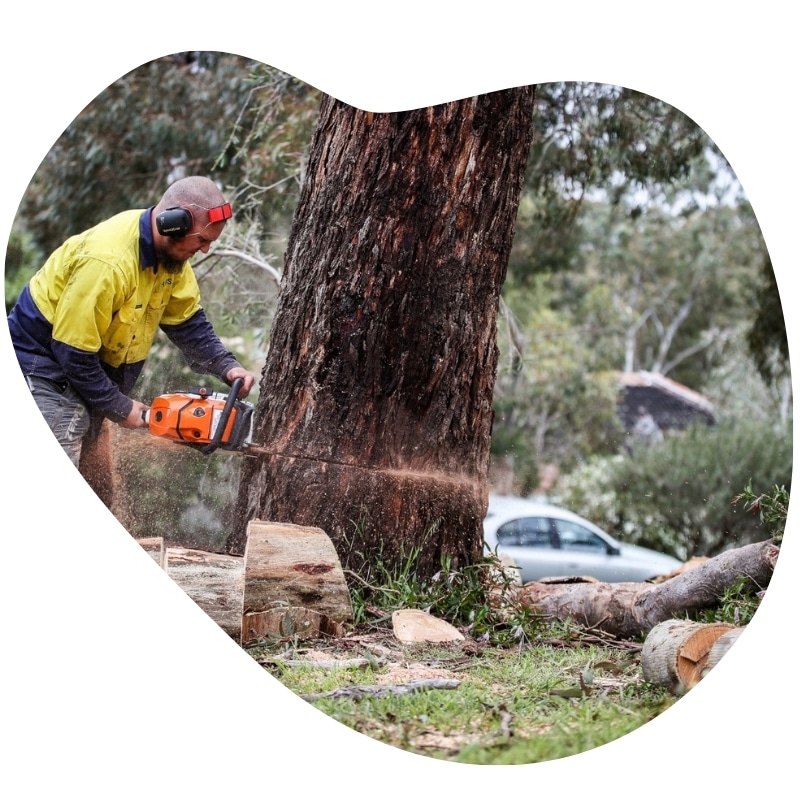
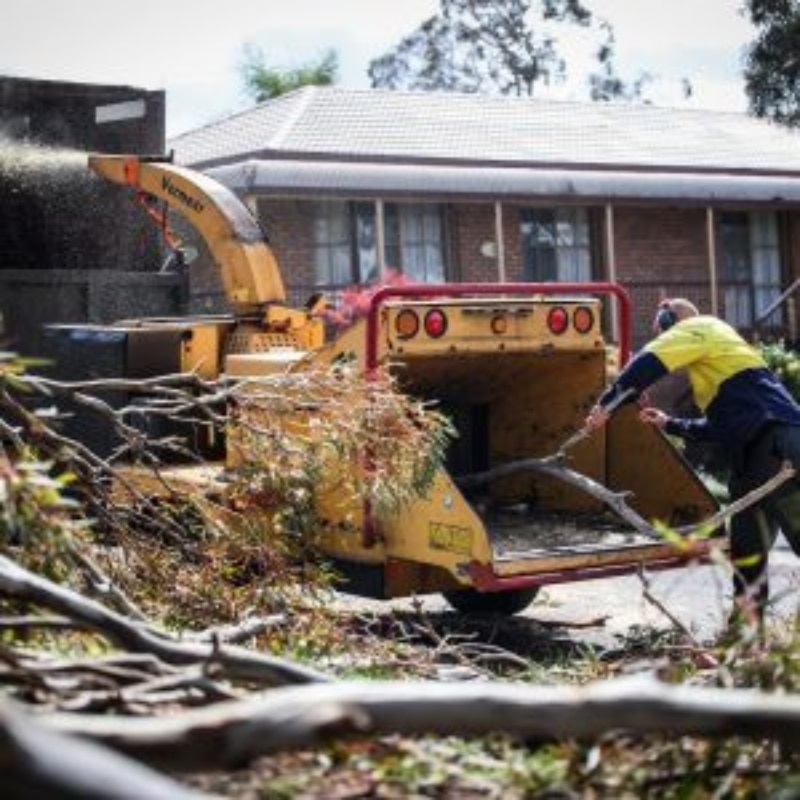
A standard visit runs in a set order: a walk around the tree and the boundaries, protective matting or boards where we will land timber, canopy reduction from the top down, stem removal in rounds, then chipping, loading and a clean-up pass with rakes and a blower. On a street tree or a verge-side job we also look at whether the truck and chipper can sit legally without blocking the court.
Storm damage and leaners on estate fence lines
Burnside catches the westerly weather coming across the open paddocks and newer estates, and the trees that fail first are the ones with a one-sided canopy leaning over a fence. A fresh lean, lifted soil at the base, or a split fork is a job for same-day attention rather than a scheduled booking, and if a tree is already on a fence, a roof or a car, call it in as emergency tree removal so it is triaged properly instead of sitting in the quote queue.
Dead and declining eucalypts
Dead gums are common on the older pockets of Burnside where trees were planted when the estates went in and have since outgrown the soil volume available to them. Deadwood is brittle, so a climber cannot rely on limbs the way they would in a live tree. These removals are usually taken with a longer rigging setup, or from an elevated work platform where the driveway allows one, and they are the type of tree most worth dealing with before a storm does it for you.
Trees lifting driveways and concrete slabs
Surface roots under exposed aggregate driveways and alfresco slabs are a regular complaint here, partly because the planting strips in newer estates are narrow and the soil compacts hard. Root pruning sometimes buys a few years, but once a stem is pushing a slab and the crack is widening, removal plus grinding is the honest answer. We look at what is under the paving before we commit to a method, because cutting a structural root can destabilise the tree we are about to climb.
Ornamental pears and robinias outgrowing small front yards
Ornamental pears and robinias were planted across the Melton estates as neat feature trees and many have now doubled the size anyone expected. In a lot of those cases pruning may be the better option than taking the whole tree out, particularly where the tree still gives useful shade to a west-facing front window. Robinias are the exception worth watching, because they sucker aggressively and a removal without follow-up grinding can leave you chasing shoots across the lawn for years.
The tree services Burnside homeowners ask for most
Full removal is the most requested job in Burnside, followed by stump grinding after a previous contractor left the stump, then crown reduction on front-yard ornamentals. Storm call-outs spike after a westerly front, and block clearing comes up on the newer subdivision edges where vacant land is being prepared.
The job list in Burnside is fairly predictable because the housing stock and the planting are of a similar age across most of the suburb. Full removal leads, usually on a gum or a pear that has outgrown the space it was given. Stump grinding is the second most common call, often months after someone else felled a tree and walked away from the stump. Crown reduction on front-yard feature trees sits third, and after a big westerly there is a run of urgent work on split limbs and leaners.
On the newer subdivision edges, where paddock land is still being turned into housing, the request changes shape entirely. Instead of one tree in a backyard it is clearing a whole block before a build, which is a machinery job with different access, waste and timing to a residential removal. The method we quote is driven by what the tree is doing and what sits around it, not by what is quickest to sell.
Tree Removal in Burnside
Climbing and rigging over pools, pergolas and shared fences, with the stem taken down in short rounds.
Get a removal quoteStump Grinding across Burnside
Stumps ground below surface level, including ones left behind by another contractor, ready to turf, pave or replant.
Stump Grinding detailsTree Pruning in Burnside
Crown reduction on front-yard pears and robinias that have outgrown the space, keeping the shade where it helps.
Tree Pruning detailsEmergency Tree Removal across Burnside
Leaners, split forks and trees already on a fence, roof or car, handled on a make-safe first basis.
Emergency Tree Removal detailsTree Mulching in Burnside
Branches chipped on site and tipped where you want them, handy for garden beds still filling after a build.
Tree Mulching detailsLand Clearing near Burnside
Whole-block clearing on the subdivision edges, planned around machinery access, waste volumes and build timing.
Land Clearing detailsNot sure which service you need? Ask us for a tailored quote.
Common Burnside trees and how each one comes down
Burnside yards are dominated by eucalypts, ornamental pears, robinias, bottlebrush and a scattering of cypress and liquidambar. Eucalypts and cypress almost always need climbing and rigging. Pears, robinias and bottlebrush are smaller and often come down in two or three cuts with a ground crew and a chipper at the kerb.
Eucalypts are the species that dictates how a Burnside job is planned. They grow tall before they grow wide, shed limbs in heat and wind, and carry heavy wood that cannot be dropped near a pool fence or a Colorbond boundary. A climber works from the top down, lowering limbs on a rigging line to a ground team that feeds the chipper, then takes the stem in rounds small enough to carry out by hand if the truck cannot get close.
Cypress and conifers hold dense foliage all the way down, so they chip in large volumes and fill a truck faster than their height suggests. Liquidambars drop heavy seed pods and have brittle upper wood. Ornamental pears, robinias and bottlebrush are the straightforward end of the work: a short climb or a pole saw, a clean fell into the yard where there is room, and a quick chip-and-load. The species changes the time on site far more than it changes the method.
What drives the price of tree removal in Burnside
Price comes down to how long the tree takes to dismantle safely and how far the timber has to travel to the truck. Height, stem diameter, condition, what sits underneath the canopy and whether a machine can reach the tree are the five factors that move a quote the most.
Two trees of the same height on the same street can be quoted very differently. One sits in an open rear yard with double gates and a driveway the chipper can back into. The other is boxed in by a pool, a retaining wall and the neighbour's patio roof, which means every limb is roped, lowered, carried through the house side and chipped at the kerb. The second tree is the same tree and twice the labour.
Height, stem diameter and tree condition
Height sets the climbing time and the rigging setup. Stem diameter sets how the trunk is sectioned and how much weight each piece carries, which is why a thick, squat gum can cost more than a taller, slimmer one. Condition changes the risk profile completely: a dead or hollow stem cannot be loaded the way sound timber can, so the crew works in smaller pieces from more conservative anchor points, and that time goes into the quote.
Powerlines, pools and shared fences
What sits under the canopy matters as much as the tree. Service lines running to the house, a fibreglass pool shell, a glass pool fence, solar panels or a neighbour's pergola all remove the option of a free drop, so every piece is lowered under control. Where branches are inside the no-go clearance of a powerline, the work has to be coordinated with the relevant distributor before a saw starts, and that coordination is part of the job rather than an afterthought.
Access, cranes and getting gear down a Burnside court
Access decides the method. Where a truck and chipper can park legally within a hose length of the tree, the job runs fast. On a narrow court, a battleaxe block or a rear yard behind a single gate, the timber is carried out by hand or lifted over the roof with a crane, and the day gets longer.
Burnside is built around courts, crescents and short no-through roads, which look quiet but are tight for a tipper and a chipper parked nose to tail. We check kerb space, driveway crossovers, overhead lines at the kerb and whether neighbours need warning before the day, because a chipper that has to sit three doors down adds a carry to every single branch.
A crane is brought in when there is genuinely no drop zone and no clear carry path, most often for a large gum in a rear corner surrounded by a pool, a shed and two neighbouring yards. The crane lifts whole sections out over the roof to the street, which can turn a two-day hand job into a controlled morning. It is not the cheap option on paper, but on the right block it reduces both the hours and the risk to what is underneath the tree.
Rear access through a single-width side gate
Most Burnside homes have one side path, often under a metre wide, with a meter box, an air conditioning unit and a rainwater tank in the way. Everything that comes out of the backyard has to fit through that gap. We measure it before quoting, lay boards where the path is pavers or soft lawn, and size the cut pieces to what two people can carry without catching a wall. If the gap is impassable, the alternatives are a crane, a neighbour's driveway with permission, or removing a fence panel and putting it back at the end of the day.
Request my quoteDo you need a City of Melton permit to remove a tree in Burnside?
Sometimes. Burnside falls within the City of Melton, and a tree can be protected by a council local law, a planning scheme overlay recorded on your title, or a condition set when the estate was approved. Check your planning certificate and the council's current rules before you book the work.
The usual triggers are a vegetation protection or environmental significance overlay on the property, a native tree over a certain size, a tree shown on an approved landscape or subdivision plan, or a street tree on the nature strip, which belongs to council rather than to the adjoining owner. Dead, dangerous or storm-damaged trees are often treated differently, but exemptions are specific and the safest step is a quick check rather than an assumption.
Protected and native vegetation checks
Indigenous remnant vegetation still exists in pockets around the Melton growth corridor, and native trees can attract state as well as local controls. If your title shows an overlay, council will normally want a written description of the tree, the reason for removal and sometimes an arborist report before a decision is made. We can describe the tree, its condition and the defects we can see so the application is based on what is actually in the yard, and we will tell you plainly when we think a permit is likely to be required. Confirmation of the current local law always comes from the City of Melton directly.
Removal, pruning or stump grinding: picking the right job
Not every problem tree needs to come out. A healthy tree casting too much shade is usually a pruning job. A structurally failing tree, or one lifting a slab, is a removal. A stump left behind by someone else is a grinding job on its own. The table below sets out which is which.
| Situation in the yard | Recommended job | Access or equipment usually needed | What is left on site | Typical disruption to the yard |
|---|---|---|---|---|
| Leaning or storm-damaged tree, lifted soil or a split fork | Urgent removal, or a make-safe first if the tree is on a structure | Climber and rigging, truck and chipper at the kerb, sometimes traffic control | Stump cut low, timber removed, area raked and blown clean | High for part of a day, with vehicles and ropes across the work zone |
| Dead or declining eucalypt with brittle deadwood | Full removal, planned rather than urgent unless it overhangs a structure | Conservative rigging, elevated work platform where the driveway allows | Stump cut low, trunk rounds taken away or stacked if you want firewood | Moderate to high, with ground protection under the drop and carry path |
| Overgrown but healthy tree blocking light or overhanging a roof | Crown reduction or selective pruning, not removal | Climber with hand saws and a pole saw, small chipper at the kerb | Tree retained with a reshaped canopy, offcuts chipped and taken away | Low, usually a half day with the yard usable the same afternoon |
| Surface roots lifting a driveway, path or alfresco slab | Removal followed by stump grinding so regrowth and roots stop working | Climber or crane depending on position, grinder brought in afterwards | Ground out root plate below surface level, grindings raked back or removed | Moderate, with grinding dust and a bare patch where the stump sat |
| Stump left behind after a previous felling | Stump grinding only, as a standalone visit | Grinder that fits the side gate, boards over soft lawn and paving | Hole backfilled with grindings, ready to top with soil and turf | Low, generally a couple of hours with no climbing involved |
Stump grinding and replanting after removal
A removal normally finishes with the stump cut as low as the saw can safely go, because the grinder is a different machine and often a separate visit. If you want the ground back to usable lawn, paving or a new garden bed, we can bring the grinder in and grind the stump out below ground level so the root plate stops holding the space. Grindings are raked back into the hole or carted away, and the patch is topped with soil if you are turfing.
One point worth planning for: fresh grindings draw nitrogen out of the soil as they break down, so a new tree or shrub does better in clean topsoil rather than straight into the chip. On a standard estate block, picking a replacement with a smaller mature canopy, something that tops out under six or seven metres, usually avoids repeating the same problem in fifteen years.
How quickly we reach Burnside from Ravenhall
Burnside sits a short drive from our Ravenhall base, straight along the Western Freeway corridor. That proximity means site visits are easy to slot in and booked works rarely need a long lead time. Exact dates depend on crew availability, the size of the job and whether a crane or traffic management is involved.
Send the street and tree
Tell us where it is, what is around it and whether it is damaged or urgent.
Site visit
We look at height, condition, access and what the yard can take before pricing.
Written quote
The figure and the scope are put in writing before anything is booked.
Booked date
A morning or afternoon window, with the site raked and blown before we leave.
Short travel distance changes more than the arrival time. A crew that is close by can come back the next morning to finish a chip-out, drop a grinder in for an hour between larger jobs, or swing past after a storm to look at a leaner before committing to a full booking. It also keeps the gear practical: the chipper and tipper come straight from the yard rather than being staged somewhere, which matters when a Burnside court has nowhere to park a float.
If the tree is damaged and you are worried about it overnight, say so in the first message. Urgent work is handled differently to planned removals, and emergency tree removal runs on a make-safe first approach rather than a scheduled start date. For everything else, the usual sequence is a site visit, a written quote, then a booked date with a morning or afternoon window.
What we leave behind: timber, mulch and a clean site
A finished removal should look like the tree was never there. Branches go through the chipper, trunk sections are cut into rounds and loaded out or stacked for firewood if you want them, and the work area is raked and blown so the lawn, driveway and footpath are clear before the truck leaves.
Clean-up is where a lot of small frustrations live on an estate block. Woodchip trodden into pale concrete, sawdust blown into a pool, ruts left in soft lawn after wet weather. We work off boards on soft ground, keep the drop zone tarped where there is turf worth protecting, and sweep the kerb and nature strip as well as the yard, because that is the part the neighbours see. If there is a pool, the cover goes on or the skimmer is checked before we start cutting.
The green waste does not have to leave with us. Plenty of Burnside yards are still filling garden beds after a recent build, so ask and we can turn the branches into mulch for your garden beds and tip it where you want it rather than carting it away. Trunk rounds can be left in a stack against a fence line if you burn firewood, though it is worth knowing eucalypt needs a long season to dry before it is any good in a heater.
Burnside jobs, reviews and local proof
Burnside is a Melton East pocket of 1990s and 2000s estate housing, bounded by the freeway, Burnside Heights and the Kororoit Creek corridor. The tree stock reads exactly like that history: fast-growing street and garden plantings now at full size on blocks that were designed around much smaller canopies.
That is the local pattern we work to. Front yards planted with ornamental pear, robinia and photinia at handover, now shouldering the eaves. Rear boundaries with a single eucalypt or a row of cypress that went in as a screen and has outgrown the fence. Creek-side streets where remnant and regrowth natives sit close to newer fencing. None of it is unusual, and all of it changes how a removal is planned, which is why a quote for a Burnside backyard eucalypt looks nothing like a quote for a front-yard pear two streets away.
We document jobs on site with before and after photographs and can walk you through comparable work at the quote stage, so you can see how a tree of similar size and position was dismantled rather than taking a description on trust. Below are recent jobs from across the City of Melton estates that Burnside belongs to.
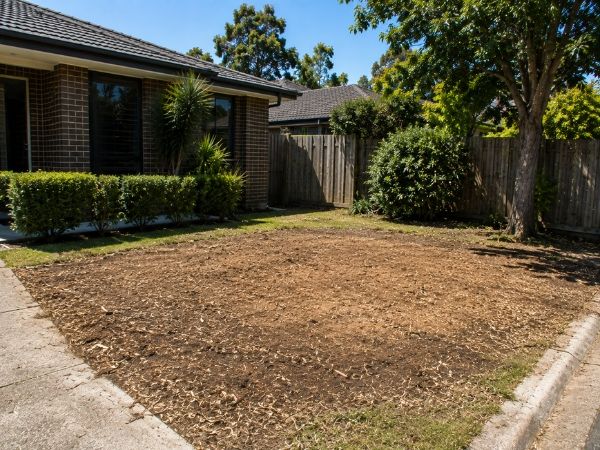
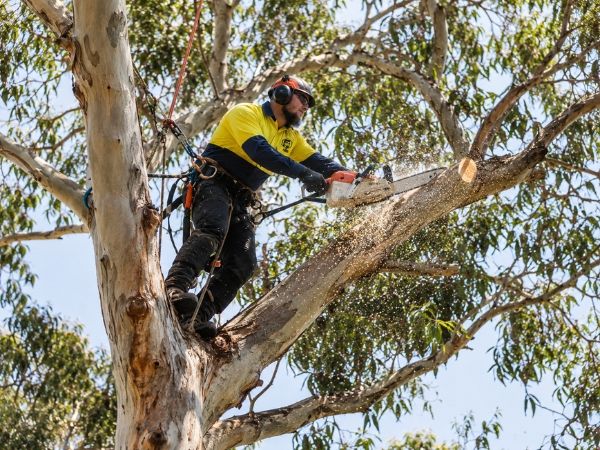
Rated 5.0 on Google by Melbourne customers
Real reviews from The Yard customers on Google.
"Straight forward process, extremely reasonable pricing. Haris was easy to deal with. Very professional, came with the right machinery. Great work boys!!"
"Haris is no fuss. Met on a Friday and he provided advice and a prompt quote. Next day he arrived with his team and performed the job safely, skillfully, efficiently and cleaned up entirely before leaving. We can recommend him."
"The boys did a great job in a very awkward location in the backyard on a 10 meter gum tree. Their price was competitive and they even took the mulch to our community garden and unloaded in a difficult spot without complaint."
Streets and pockets of Burnside we cover
We cover all of Burnside in postcode 3023, from the streets backing the Western Freeway through to the Kororoit Creek reserve edge and the courts off Westwood Drive and Ballarat Road. Boundary addresses that sit between Burnside, Burnside Heights, Caroline Springs, Deer Park and Albanvale are all on the same run.
Most of the suburb is cul-de-sac estate layout, which means the practical question is rarely whether we cover the street and almost always how the truck and chipper sit while the crew works. Narrow courts, kerbside parking on both sides and short driveways all get worked out on the site visit, and a neighbour's driveway is only ever used with their permission. Vacant and part-built lots are handled differently again: if the job is clearing a whole block before a build rather than taking one tree out of a finished yard, the planning, machinery and waste volumes change from the start.
Nearby western suburbs on the same run
Burnside sits in the middle of a tight cluster of western suburbs we service on the same schedule, so a Burnside booking often sits alongside work in Burnside Heights, Caroline Springs, Deer Park, Cairnlea and Albanvale on the same day. Burnside is part of the City of Melton, and our page on tree services across the City of Melton covers the wider council area.
Next door, the same crews handle tree services in Caroline Springs to the west and tree work in Deer Park to the south-east. A little further north-east, the same crews work on tree services in St Albans, where the housing is older and the tree stock is bigger again. If your address sits on a suburb boundary, send it with your enquiry and we will confirm coverage before a site visit is booked.
Neighbouring suburbs
Not sure whether your street is in range? Send the address with your enquiry and we will confirm coverage before booking a site visit.
Qualifications and insurance to check before work starts
Tree removal on a built-up estate block is high-risk work carried out beside houses, pools, powerlines and shared fences. Before anyone climbs, you are entitled to see who is doing the work, what they are qualified to do and what cover sits behind them if something goes wrong on your property.
Ask any tree contractor for written evidence before work starts, and check that the name on the documents matches the business quoting the job. The three things worth sighting are the arboriculture qualifications held by the climber and ground crew, current public liability cover with the policy still in date, and workers compensation for everyone on site. Also ask how the quote treats variations, what happens to the stump, and whether clean-up and green waste removal are included in the figure or added afterwards.
Our quotes set out the scope, the stump, the clean-up and the green waste in writing so you know exactly what is included before you commit, and we are happy to answer any of these questions at the site visit.
Tree removal Burnside FAQs
How much does tree removal in Burnside cost?
Do I need a council permit to remove a tree in Burnside?
How soon can you get to a tree in Burnside?
Do you take the stump out as well?
What happens to the timber and branches?
Can you remove a tree close to the house, pool or fence?
Do you work in the streets around Burnside as well?
Get a Burnside tree quote on site, not over the phone
Send the street, a photo of the tree and what is around it. We will look at height, condition, access and what the yard can take, then put the figure and the scope in writing before anything is booked.
The Yard, Unit 2/42 Ravenhall Way, Ravenhall VIC 3023. Tree removal, pruning, stump grinding and site clearing across Melbourne's west, with Burnside on our regular run.